QUAIL and other POULTRY feeding update by Back Yard Farmer

NEW FEEDING REGIMES FOR IMPROVED PRODUCTION

for Coturnix coturnix Quail and all other Wild Birds such as Pheasants, Partridge, etc

Combining my experience in animal nutrition and husbandry with extensive reading regarding the latest nutritional developments I am now manufacturing feeds that are very advanced in approach. These feeds benefit high performing quails and other wild birds such as pheasants and partridge. My birds are performing so well on these new feed formulations that I have included these formulae in all the feeds I offer for sale.

My strategy is to maximise digestibility using the simplest and best combination of materials and feed additives. I also utilise proven probiotics / prebiotics to stimulate and enhance the naive gut, creating a favourable environment for good gut flora to proliferate and keep cell junctions tight. The rations also assist gut enterocytes with function and repair, while there are some elements in the feeds that help the modulation of immune responses.

I formulate to specifications for a 28 % Protein BYF Quail Starter Feed, 26 % Protein BYF Quail Grower Feed, 24 % Protein BYF Quail Maintenance Feed and a 22 % Protein BYF Layer Feed as the top of the range diets by introducing new additives in addition to the present Vitamin and Mineral Pre Mix. These additives contain extra Lysine, Methionine, Threonine, Isoleucine and Valine which is intended to fully balance all the digestible amino acid ratios. These additions also lift the protein and energy digestibility beyond their stated levels on paper by using 4 separate and specific feed enzyme activities. The extra additives contain bioactive Vitamin D (Hy-D), Vitamin C, and Calcium Carbonate for bone modelling and antioxidant properties. Kelp meal, minerals, electrolytes and some sources of protected Butyrate, Carvacrol and Thymol steer good flora and discourage overgrowth of pathogenic bacteria and organisms. These new additions also contain a Mannosidase enzyme to aid the digestibility of various materials with proven Phytase, beta Glucanase, Xylanase and Protease enzymes.

My new feed formulations are the ultimate diets for quail and wild birds. All the above inclusions are essential and unique and take care of all amino acid balances using standard materials, supercharging the opportunity across all fronts for the birds to start well, grow well and produce well. There is plenty here to give bumble bee sized chicks, as well as mature birds, every chance to thrive without antibiotics, which is a big plus. These feeds are not only essential for wild birds, but give all poultry that extra boost when under stressful conditions.

KENTUCKY FRIED RABBIT

New Zealand has far too many rabbits. They are eating their way through the countryside ruining the pastures so we decided, as payback, that we would eat them! There are many ways to cook this lovely, lean meat and ‘Kentucky Fried Rabbit’ is the best when one has had too many stews or roasts

Even though I am not a loyal KFC customer, I know lots of people who are (Obviously not close friends of mine). When I stumbled upon an Italian food site claiming to have “acquired” the famous KFC recipe (tongue in cheek off course from the Italians) and disclosed it all on their page, I was interested. I am often asked how to cook rabbit as I have AMPLE supplies in my freezer, my standard answer always is that you can cook it in any way you cook chicken. Having made the connection between chicken and rabbit and having the secret recipe at hand, I was determined to try some KFR (Kentucky Fried Rabbit) or DFR (Dunedin Fried Rabbit) in my mission to eat every one of these NZ PESTS!!!

It was my turn to cook Saturday lunch and I thought I may as well try my new adventurous recipe on Mrs BYF. Weighing out the ingredients to the closest gram and carefully following the intricate steps of the recipe, I had some food on the plates about two hours later and to my BIG SURPRISE it was very good. Some of my regular KFC muncher “friends” even seriously commented it to be better than the famous KFC!!! Watch out Colonel here comes New Zealand!!

Recipe

1 large wild rabbit

Cut the rabbit up in portions

Use a pan big enough to fit all the rabbit pieces in a single layer

2 cups of vegetable oil for frying

1 cup potato flour for the first drenching

2 cups flour for the second drenching

1 tablespoon of smoked paprika

1 teaspoon cardamom

1 teaspoon salt or more to taste

1 teaspoon powdered ginger

1 tablespoon powdered garlic

3 eggs beaten

Method

Because one can never be sure of the age of the rabbit I steam it until it is soft but still firmly on the bone. It takes about 20 – 30 minutes for an old rabbit. This step is not required if you know it to be a young rabbit and the results are always better than cooking an older rabbit

When the steamed rabbit has cooled, pat dry and drench with the potato flour. Whisk all the dry ingredients together. Dip the rabbit pieces individually first in the egg and then in the flour mix, then dip the pieces in the egg and flour again. Heat the oil in the pan. Slip the pieces into the hot oil (the rabbit should sizzle) and fry for about 10 minutes on a side, controlling the heat so that the rabbit becomes golden brown and not burnt

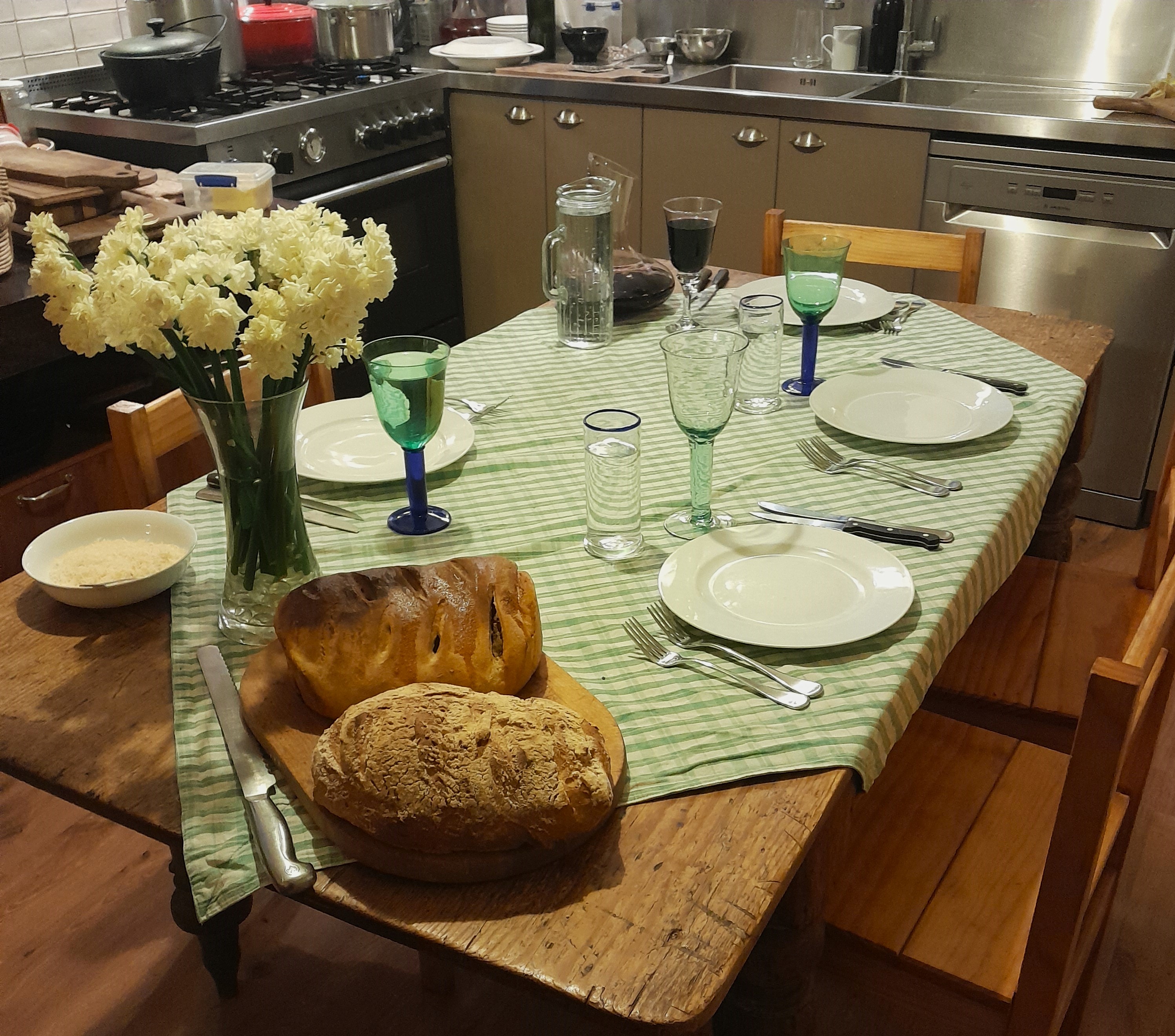
One probably should have this with mashed potato and gravy but I served it with steamed broccolini and polenta.

ENJOY with a glass of GOOD HOME MADE RED WINE

CALAMARI RIPIENI (Stuffed Squid)

We got our hands on probably the best squid we have ever had. Fresh, large, tasting of the sea. We immediately started discussing our many options, determined to make the most of it.  The recipe we settled on was a tender, flavourful dish of squid. I cleaned as much as we need and froze the rest. After making a tender and tasty squid  with wine and spinach, Mrs BYF decided to put stuffed squid on the menu for lunch.

To serve six, or two with some very nice leftovers for the rest of the week 

6  whole Squid cleaned, tentacles and fins cut off leaving the sac intact

4  tablespoons extra-virgin Olive Oil

4  Garlic cloves or more

2  tablespoons chopped Italian Parsley 

140g fresh Tomatoes.

Salt to taste

chopped Chilli or chilli flakes to taste

1 Egg yolk

15g dry Bread crumbs. White bread unflavoured.

170g thinly sliced brown Onion 

100ml dry white Wine

Toothpicks the large strong ones

Method

Chop up the fins and tentacles

To make the stuffing, cook the garlic in the 1 1/2 tablespoons of oil until slightly coloured. Add the parsley and stir a few times before adding the tentacles and fins, cook for a few minutes stirring well. Add the tomatoes and let the stuffing simmer for  about 30 minutes until the tomatoes are dense and have lost the waterlines.  When done, transfer the stuffing to a bowl and let it cool completely. Add the egg and the breadcrumbs and mix well. Mrs BYF was using quail eggs and could not be bothered to seperate the whites from the yolks. The result was still very good. 

While the tomato mix cooks, cook the chopped onion in 11/2  tablespoons of oil until golden. Meanwhile divide the stuffing in to 6 equal portions and stuff the squid sacs, secure the openings with the toothpick.

Add 1 tablespoon of olive oil to the onion and turn up the heat, cook the squid turning it until all the sides of the sacs are golden brown. Add the white wine, let it bubble away completely, put the lid on the pan and turn the heat to a very gentle simmer for 45 minutes. Add a bit of water only when there is a danger of the squid sticking to the pan. When tender, slice the sacs in to 1 or 2 cm thick slices. Return to the pan and dribble whatever juices there are over the slices. Serve immediately.

The entire process was worth while because the end result was delicious! 

ENJOY and do not forget a glass of good home made red wine

PANCETTA

By this time of the year Pancetta stocks are almost depleted in the BYF pantry and the wheater being kind, new stock will be made soon

Get some nice thick pork belly (skin off and fat on!) hopefully raised free range and chemical free, or you may be lucky enough to shoot a nice young and fat wild pig

Trim the edges so as to have an almost uniform, in thickness, belly. Now cut the belly in managable sizes of about 300 mm X 200 mm

Mix the following ingredients per Kg of meat

2 Cloves Garlic – finely chopped

1 small sprig of Rosemary – finely chopped

3 g grated Nutmeg

3 g ground Black Pepper

1 g fresh Chilli (optional) – finely chopped

Mix the spices well and thoroughly rub it into the belly, covering all the cracks and crevices

Get a container large enough to lay out the pieces of meat in a single layer. Spread a thin layer of sea salt covering the bottom of the container, then lay the pieces of meat onto the salt and cover them completely with more salt in such a way that no meat is exposed. Place the container with meat in the fridge at about 3 – 5 C for 2 days. After 2 days, remove the salt, turn the meat over, drain off any fluid and cover with the same salt and return it to the fridge. If the belly is thin (about 25 – 30 mm) remove from the fridge and discard the salt after day 3. If the belly is thicker than 30 mm, leave for another day and remover from the fridge and discard the salt after day 4

Now rinse the bellies very well with cold running water and then wash with good red or white wine

Your Pancetta are ready to commence the curing process now by hanging them in such a way that they do not touch each other. Conditions must be about 15 C for the first week and then about 7 – 10 C until ready to use. Make sure the area is well ventilated, but NO DRAFT on the meat. The Pancetta should be rotated in such a way that uniform drying is achieved

After about 30 days, depending on the thickness, ventilation and temperatures of the Pancetta, they should be ready to taste and eat when you think they are ready and of the correct consistency – no harm in eating them too soon. Always remember to slice your Pancetta VERY thin. An old hand can tell when the Pancetta is ready by just feeling them

Once the consistency and moisture content is acceptable, vacuum pack and store in the pantry

The Pancetta can be enjoyed as is or in any cooking or fried, like bacon

Another version of pancetta can be made with the skin on and the pancetta rolled and tied

ENJOY and do not forget the home red wine to compliment the good Pancetta

INCUBATION AND HATCHING RATES with Coturnix coturnix Eggs

I hatch between 30 and 40 eggs every week and keep meticulous records (ex scientist) and hatching percentage at present is about 78% (chicks alive at 3 days of age of eggs placed). This is for all eggs placed over at least a 12 month period. It also includes some batches from much older birds as well as batches of very young birds, as I may sometimes collect eggs from these before they are either sold or slaughtered. Very young and very old birds obviously have lower egg viability and hence affect the records. It is not uncommon to get 90%+ hatchings from the commercial flocks. My records also include hatchings from Male lines and Female lines, Breeding Parent Stock, where I have lower Male to Female ratios and different ages in the same cages, where hatching percentages are not always that good

I must emphasise that these results are obtained by using very good commercial incubators and hatchers (FIEM) and it is not possible to achieve these results over an extended period with most of the cheap equipment on offer nowadays. Even with my equipment, the monitors in the incubators and hatchers are not always 100 % accurate and I have seperate calibrated thermometers and wet bulb thermometers to compare all the time, making sure settings are actually achieved inside the machines.

Quail Eggs are much more sensitive / difficult to hatch compared to chicken, or most other specie, eggs

The ideal settings for my conditions for Coturnix coturnix are :

Day 1 to day 14 – RH (%) – 60

Day 1 to day 14 – Temperature (C) – 37.7

Day 15 to hatch – RH (%) – 80

Day 15 to hatch – Temperature (C) – 37.5

The following hatching conditions I have found over the years are giving the best hatching and survival rates for Coturnix coturnix quails

I collect eggs for up to 3 days, depending on how many I want to incubate, then class them for hatching.

1. Do not clean or wash the eggs at all

2. Remove any odd colours and shapes of eggs

3. Candle all eggs for fine cracks and discard cracked eggs

4. Weigh the eggs and only incubate eggs that are between 12 and 15 grams. Smaller eggs result in weaker chicks, while larger eggs (15 g plus) is not preferred since it becomes too large for the hens. The incidence of double yolks are not always detectable and is more frequent in larger eggs. I select hens for about 280 – 300 g body mass and do not breed from larger birds. This is the most economical bird and eggs size.

5. Incubators are set at 37.7 Celsius and 60% (RH) Humidity. Hatchers are set at 37.5 C and 80 % (RH) Humidity. I monitor and adjust incubators and hatchers for both these two parameters with independent monitors as incubator measuring and displays are not always that accurate, even with my FIEM commercial, sophisticated and well proven machines. I use calibrated thermometers and wet bulb thermometers. Preheat incubators and hatchers for a couple of hours before setting.

I am always trying to simulate nature during incubation and hatching and therefore keep the inside of the machines dark, as if under a hen. Furthermore there are some research published lately suggesting to have better hatching results if the incubators and hatchers are switched off for about 30 minutes every day, again simulating the hen getting up to eat. I have not tried it, but will experiment with this soon.

Keep hatchers and incubators in an environment as close as possible to the setting parameters. Also avoid fluctuations in conditions and make sure there are no drafts, but it should be very well ventilated.

6. Coturnix coturnix eggs are incubated for 14 days (37.7 Celsius and 60 % (RH) Humidity) while automatically turned every 2 hours. Then they go into the hatcher (37.5 C and 80 % (RH) Humidity) until hatching at about 17 days. I leave the chicks undisturbed for 24 – 36 hours after the first chick hatched and then move all the hatched chicks to the brooders and stop hatching. I do not assist any chicks that struggle to hatch, or still in the eggs.

HATCHING TIMES

I use the same incubation and hatching parameters for many other species as well. All are moved to the hatchers 3 days prior to hatching and are just left in the incubators until 3 days before hatching, whatever time that may be.

Pheasants 24 Days (21 + 3)

Partridge 23 Days (20 + 3)

Bob White Quail 23 Days (20 + 3)

Californian Quail 22 Days (19 + 3)

Coturnix coturnix 17 Days (14 + 3)