UPSIDE DOWN BANANA BOXES

INSIDE TE HATCHERY

For many years I used plastic brooders to grow my small quails in and it worked very well. The problem came having to clean these all the time and since I replace about 10 of these in my hatchery every week, it became a very laborious and unpleasant task. A water blaster was the only way to clean them properly which created a lot of effluent as well. Alternatives were investigated and I settled on Banana Boxes. The advantage is that there is no cleaning as I just replace the used box with a new and clean one. The downside was that I had 10 manure and bedding “soiled” banana boxes every week. I solved this by flattening the boxes and turn them upside down in my garden with the manure and bedding underneath and the box on top. This makes a wonderful source of nutrients fertilising the soil and also an excellent weed mat.


The results are excellent from a plant growth point of view and I have also not seen that many earthworms in all my live. I normally leave the boxes, well watered, for a couple of months before drilling a 40 mm hole about 200 mm deep through the box into the ground, fill it with good quality soil and plant the new plants or seeds it the hole. One needs to pack the boxes down in the beginning (I use old bricks) until the plants are stronger, otherwise the boxes move too much and the hole is not over the seed any more, or the small plants get damaged. After about 1 month the boxes have disintegrated and the bricks can be removed. The plants are now strong enough, weed free and well fertilised.

Ready to plant an Artichoke Forrest

One of the many Tomato beds ready for planting
Brassicas are very happy
Garlic is going very well
Boxes are well disintegrated after 6 weeks

QUAIL and other POULTRY feeding update by Back Yard Farmer

NEW FEEDING REGIMES FOR IMPROVED PRODUCTION

for Coturnix coturnix Quail and all other Wild Birds such as Pheasants, Partridge, etc

Combining my experience in animal nutrition and husbandry with extensive reading regarding the latest nutritional developments I am now manufacturing feeds that are very advanced in approach. These feeds benefit high performing quails and other wild birds such as pheasants and partridge. My birds are performing so well on these new feed formulations that I have included these formulae in all the feeds I offer for sale.

My strategy is to maximise digestibility using the simplest and best combination of materials and feed additives. I also utilise proven probiotics / prebiotics to stimulate and enhance the naive gut, creating a favourable environment for good gut flora to proliferate and keep cell junctions tight. The rations also assist gut enterocytes with function and repair, while there are some elements in the feeds that help the modulation of immune responses.

I formulate to specifications for a 28 % Protein BYF Quail Starter Feed, 26 % Protein BYF Quail Grower Feed, 24 % Protein BYF Quail Maintenance Feed and a 22 % Protein BYF Layer Feed as the top of the range diets by introducing new additives in addition to the present Vitamin and Mineral Pre Mix. These additives contain extra Lysine, Methionine, Threonine, Isoleucine and Valine which is intended to fully balance all the digestible amino acid ratios. These additions also lift the protein and energy digestibility beyond their stated levels on paper by using 4 separate and specific feed enzyme activities. The extra additives contain bioactive Vitamin D (Hy-D), Vitamin C, and Calcium Carbonate for bone modelling and antioxidant properties. Kelp meal, minerals, electrolytes and some sources of protected Butyrate, Carvacrol and Thymol steer good flora and discourage overgrowth of pathogenic bacteria and organisms. These new additions also contain a Mannosidase enzyme to aid the digestibility of various materials with proven Phytase, beta Glucanase, Xylanase and Protease enzymes.

My new feed formulations are the ultimate diets for quail and wild birds. All the above inclusions are essential and unique and take care of all amino acid balances using standard materials, supercharging the opportunity across all fronts for the birds to start well, grow well and produce well. There is plenty here to give bumble bee sized chicks, as well as mature birds, every chance to thrive without antibiotics, which is a big plus. These feeds are not only essential for wild birds, but give all poultry that extra boost when under stressful conditions.

INCUBATION AND HATCHING RATES with Coturnix coturnix Eggs

I hatch between 30 and 40 eggs every week and keep meticulous records (ex scientist) and hatching percentage at present is about 78% (chicks alive at 3 days of age of eggs placed). This is for all eggs placed over at least a 12 month period. It also includes some batches from much older birds as well as batches of very young birds, as I may sometimes collect eggs from these before they are either sold or slaughtered. Very young and very old birds obviously have lower egg viability and hence affect the records. It is not uncommon to get 90%+ hatchings from the commercial flocks. My records also include hatchings from Male lines and Female lines, Breeding Parent Stock, where I have lower Male to Female ratios and different ages in the same cages, where hatching percentages are not always that good

I must emphasise that these results are obtained by using very good commercial incubators and hatchers (FIEM) and it is not possible to achieve these results over an extended period with most of the cheap equipment on offer nowadays. Even with my equipment, the monitors in the incubators and hatchers are not always 100 % accurate and I have seperate calibrated thermometers and wet bulb thermometers to compare all the time, making sure settings are actually achieved inside the machines.

Quail Eggs are much more sensitive / difficult to hatch compared to chicken, or most other specie, eggs

The ideal settings for my conditions for Coturnix coturnix are :

Day 1 to day 14 – RH (%) – 60

Day 1 to day 14 – Temperature (C) – 37.7

Day 15 to hatch – RH (%) – 80

Day 15 to hatch – Temperature (C) – 37.5

The following hatching conditions I have found over the years are giving the best hatching and survival rates for Coturnix coturnix quails

I collect eggs for up to 3 days, depending on how many I want to incubate, then class them for hatching.

1. Do not clean or wash the eggs at all

2. Remove any odd colours and shapes of eggs

3. Candle all eggs for fine cracks and discard cracked eggs

4. Weigh the eggs and only incubate eggs that are between 12 and 15 grams. Smaller eggs result in weaker chicks, while larger eggs (15 g plus) is not preferred since it becomes too large for the hens. The incidence of double yolks are not always detectable and is more frequent in larger eggs. I select hens for about 280 – 300 g body mass and do not breed from larger birds. This is the most economical bird and eggs size.

5. Incubators are set at 37.7 Celsius and 60% (RH) Humidity. Hatchers are set at 37.5 C and 80 % (RH) Humidity. I monitor and adjust incubators and hatchers for both these two parameters with independent monitors as incubator measuring and displays are not always that accurate, even with my FIEM commercial, sophisticated and well proven machines. I use calibrated thermometers and wet bulb thermometers. Preheat incubators and hatchers for a couple of hours before setting.

I am always trying to simulate nature during incubation and hatching and therefore keep the inside of the machines dark, as if under a hen. Furthermore there are some research published lately suggesting to have better hatching results if the incubators and hatchers are switched off for about 30 minutes every day, again simulating the hen getting up to eat. I have not tried it, but will experiment with this soon.

Keep hatchers and incubators in an environment as close as possible to the setting parameters. Also avoid fluctuations in conditions and make sure there are no drafts, but it should be very well ventilated.

6. Coturnix coturnix eggs are incubated for 14 days (37.7 Celsius and 60 % (RH) Humidity) while automatically turned every 2 hours. Then they go into the hatcher (37.5 C and 80 % (RH) Humidity) until hatching at about 17 days. I leave the chicks undisturbed for 24 – 36 hours after the first chick hatched and then move all the hatched chicks to the brooders and stop hatching. I do not assist any chicks that struggle to hatch, or still in the eggs.

HATCHING TIMES

I use the same incubation and hatching parameters for many other species as well. All are moved to the hatchers 3 days prior to hatching and are just left in the incubators until 3 days before hatching, whatever time that may be.

Pheasants 24 Days (21 + 3)

Partridge 23 Days (20 + 3)

Bob White Quail 23 Days (20 + 3)

Californian Quail 22 Days (19 + 3)

Coturnix coturnix 17 Days (14 + 3)

JAPANESE QUAILS DO NOT EXIST

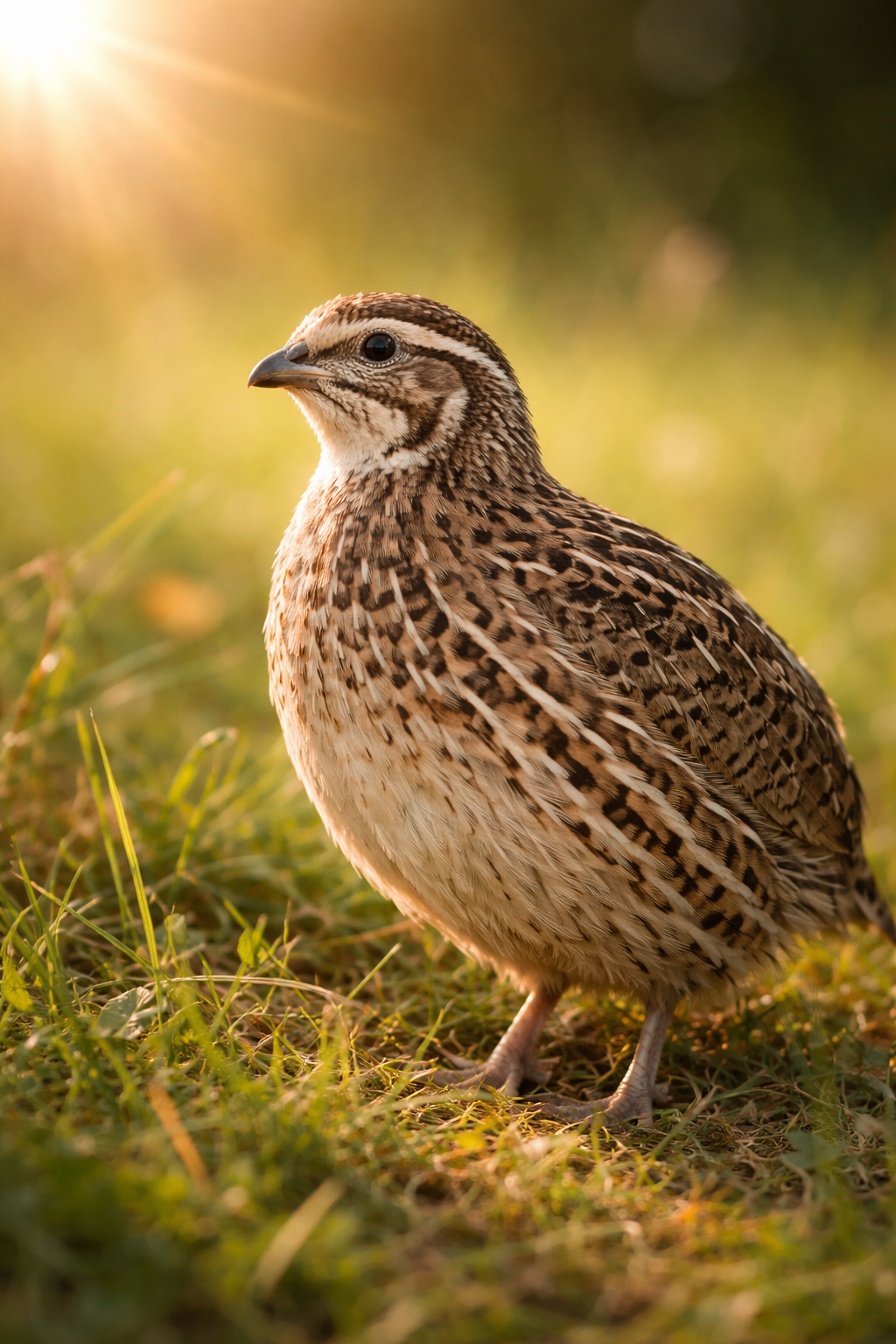
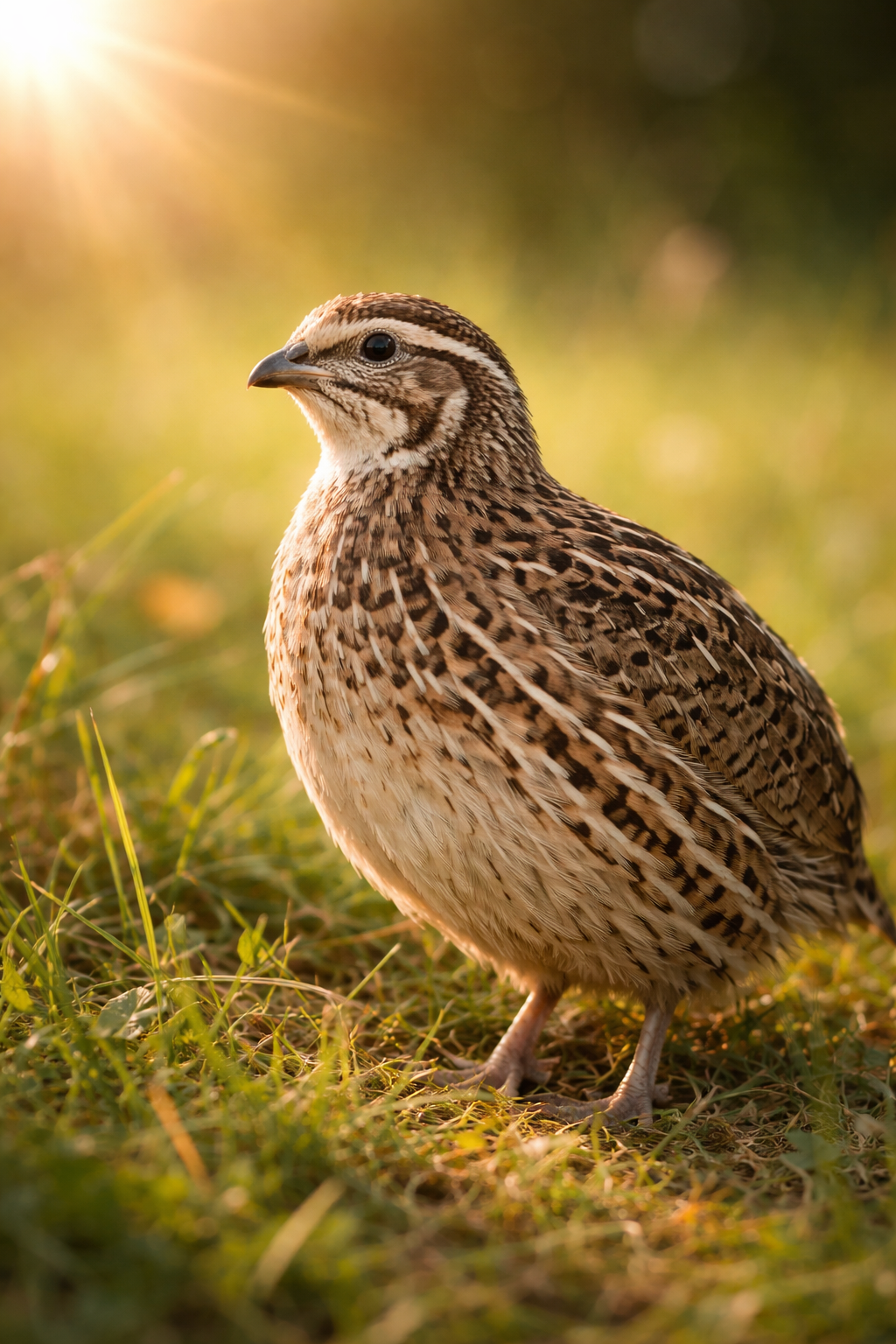
A good example of a Pharoah Breed of Coturnix coturnix quail

The quails that I mentioned, Coturnix coturnix, all have some commercial value somewhere in the world for hunting, eggs, meat and research purposes, whereas Button and Chinese quails are purely decorative and known by a different name everywhere. All quails are called different names in different parts of the world and as soon as money gets involved, the facts are starting to be distorted, but we cannot create species at will. Hence there is no such species of animal as a Coturnix japonica. Mediterranean quails, Coturnix coturnix, roam freely in the Mediterranean. I have an estate in the Po Valley in Italy where Coturnix coturnix are abundant still today. The “problem” with Coturnix coturnix is that it is such an adaptable animal in captivity with such great production capacities and very short generation intervals that it is being favoured all over the world by researchers and commercial producers alike. These Mediterranean birds migrate over to North Africa every year and the Egyptian Pharaohs have caught and domesticated them many hundreds of years ago. Some time later the Japanese Emperors purchased some from the Pharaohs for their song apparently – which is just another nonsense as Coturnix coturnix does not have any singing sound and would probably be the last bird you would acquired for such.  Because of the special qualities of Coturnix coturnix they were and are being kept in every corner of the world and as such various mutations happened over the years and combined with selective breeding, new breeds have evolved (Tibetans, Golden Italians, Whites, Etc, Etc), but no new species has sprung up from somewhere. As an example the latest meat Ross and Cobb chickens are different breeds, but still Gallus gallus, not a new species. Similarly Jumbo, White, Golden Italian, Tibetans, Common quails, call them what you like, are different BREEDS, but not different SPECIES – still Coturnix coturnix. Similarly an Alsation, Bulldog, Greyhound and Chihauhau are all different breeds of dogs and not different species of animals and all are Canis lupus https://backyardfarmer.co.nz/quails/

As soon as money gets involved people make all sorts of claims for personal benefit

Do not believe everything you read on Wikepedia either

In New Zealand, the problem is that as result of legislation, no new Coturnix coturnix have entered the country for many decades, resulting that ALL Coturnix coturnix in NZ being related, inbred and mongrels with poor production capacities compared to birds in other parts of the world (Maybe we must apply for a Coturnix newzealandia nomenclature for an exceptionally poor example of the species) The problem with the breed in New Zealand is that there is no overseeing controlling body that monitors matters and every person with a male and a female call themselves “breeders”, whereas they are just multipliers doing more harm than good to the species. As a qualified geneticist (retired) I am, as a hobby, trying to breed a better Coturnix coturnix in New Zealand and have achieved good results over the 10 years that I lived in New Zealand

There is no such species of animal as a Coturnix japonica or Japanese Quails

FEED YOUR QUAILS PROPER AND CORRECTLY !!

I have recently decided to publish one of the many feeding comparisons / trials I do from time to time, which I think will assist the many people asking common questions about what to feed quails, and more specifically Coturnix coturnix Quails

TRIAL

I divided 66 day old Quails, all hatched from the same parent groups and hatching batch, into 6 groups of 11 each. Subjected them to 3 different treatments of two groups per treatment

TREATMENT 1 – Fed this group the standard Back Yard Farmer regime of 28 % Protein Quail Starter Mash from day 1 – day 21 of age, then switch to 26 % Protein Quail Growers Mash

TREATMENT 2 – Fed this group NXX Meatbird Crumble as per manufacturers recommendation

TREATMENT 3 – Fed this group WX Game Bird Crumble as per manufacturers recommendation

I am now quoting some of the results obtained up to 42 days of age. The intention was to follow this through to full egg production at 12 weeks of age, but for the benefit of the birds, I decided to terminate the trial at 42 days of age.

TREATMENT 1TREATMENT 2TREATMENT 3
Body mass at 16 days – g1057273
Body Mass at 24 days – g168122111
Body Mass at 31 days – g198142130
Body Mass at 42 days – g260212201
Mortality at 42 days – %0.00%13.60%22.70%

With the above results taken into consideration, I decided to terminate the trial for the benefit of the birds in some of the groups.

I have collected many more data from these trials and subjected the results to proper statistical analyses, but I think it superfluous to report