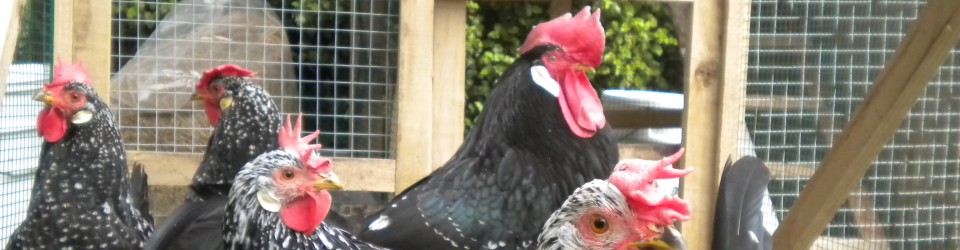
hen spats

Image,

This week  three lovely new Ancona hens arrived, unrelated to each other or the rooster and older hens. Needless to say, the established hens hate the new girls. All my cages are occupied so I could not introduce them in the correct manner by putting them in a cage beside the main run so they could get used to one another, just put them with the others straight away. Now  the new girls are holed up in the roost and the old girls are downstairs preventing the new ones from coming down to eat. I have to feed them up there and clean out the messy roost regularly. The rooster is having a great time entertaining upstairs as well as downstairs! Next time I shall BUILD a cage for the newcomers no matter what and do things the right way to save myself time, work and stress.

Egg Storage Position before Incubation

2014-04-19 - Quail Eggs StorageSmall End Up Storage
Eggs are normally stored in the large end up position. In this position, the embryo is located
beneath the air cell. After oviposition, the egg loses water and the air cell increases. It is
hypothesized that the embryo has a higher chance to dehydrate or to stick to the internal
eggshell membrane when the egg is stored in the large end up position rather than in the small
end up position.

Research has shown that when eggs are stored longer than 7 days, the decline in hatchability
can be reduced by 15% when eggs are stored in the small end up position instead of the large
end up position. This is due to a reduction in early and late embryonic mortality. The positive
effect on hatchability depends on several factors such as breeder flock age, storage conditions,
quality of the egg components, and embryo viability.


http://ps.oxfordjournals.org/content/87/6/1237.short