Rabbit Coratella with Artichokes

2016-01-13 - Rabbit and Artichoke Coratella


Old recipes that use meats that are these days regulated to the garbage or pets abound in Italy. The problem is that offal is not generally obtainable. Slaughtering my own animals has huge advantages!

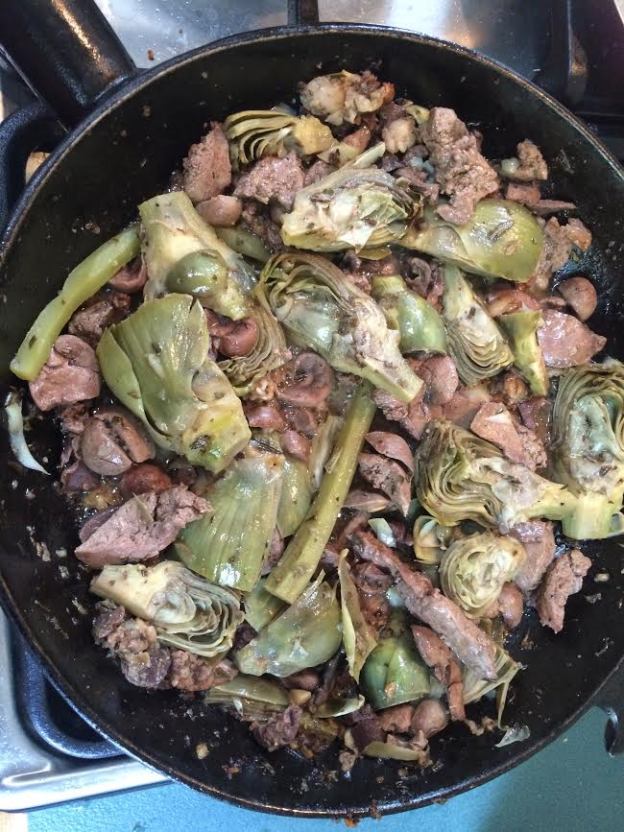
With a few rabbit carcasses in the freezer, we decided to make a dish with the coratella (heart, liver, spleen, kidneys and lungs) incorporating some of the artichokes that we now have in abundance. Mrs BYO created the dish and did the cooking, serving it with the staple of the North, polenta. It was a delicious meal and we have all of the rabbit left to feed the more fussy members of the tribe.

CORATELLA CON CARCIOFI

As many cleaned rabbit offals as you can get your hands on, but at least 4, cut in small pieces

1/2 cup rabbit fat. The fat surrounding the kidneys are the best. alternatively use 1/2 cup olive oil

4 large garlic cloves roughly chopped

2 tablespoons of finely chopped rosemary

white wine

4 or 5 artichokes, cleaned and prepared, cut into 4 sections. All the green leaves of the artichoke must be snapped off and the choke removed, leaving only the tender white parts of the leaves and the heart

salt and pepper

Heat the fat in the pan on a low heat until the fat runs clear and only small bits of browned fat remains in the pan. Saute the garlic and rosemary in the fat until the garlic is golden. Add the rabbit, season with salt and pepper and brown everything quickly over a high heat. Sprinkle with a bit of wine. Lower the heat and cook the rabbit for about 10 minutes, regularly sprinkling the meat with wine, then add the artichokes. Sprinkle wine generously and cook uncovered, turning the artichokes often. When the artichokes are tender, serve  hot with polenta or bread.


Mean Rabbit Shredder

Following my very unsuccessful rabbit breeding effort I have placed the plump doe with a hired stud and am hoping for the best (cost me a lot of money). Now for the Buck that was actually a Doe (I think) I have allocated a new abode and re-categorised her as a Breeder.

After everything calmed down I again became suspicious about the sex of the ‘new’ breeding doe and decided to first consult Google on how to sex your rabbits and came across a very handy you tube demonstration. I shared the article with a couple of my friends to get their opinion and was warned to be careful as an angry doe can be vicious and mean (like most females). Me being a seasoned farmer and rabbit breeder, I  caught the lady for inspection – the long and the short of the story is she disapproved of the procedure and now look at my arm!!


2015-12-11 - Rabbit shredder

Rabbit Stalemate

2015-12-03 - Stalemate

I have never thought that my first biology lesson in year four would haunt me 60 years later. Anyhow my rabbit operation is very simple. I breed for the pot only and have three does and one buck that I mate once every two months. Every doe breeds twice a year which gives me 6 – 8 rabbits after sales and replacements for the pot every 8 weeks. I replace the older does every so often with a good specimen out of a litter and replace the buck with a new purchase as frequently as required to introduce new genes. When a friend of mine said that she has a New Zealand White buck and we should swap bucks as our breeding animals were not related, I thought it a great way to introduce fresh genes into both our operations. She was kind enough to bring her young man around and took my old buck away. I had a doe to breed and, as I normally do, I placed the buck with the doe for 25 days. When I moved the buck to his own cage I was certain that some days later I would have a litter. Last week it was time to slaughter and I butchered all the young ones except a very good looking young doe that I kept for breeding. The following day the buck’s 25 days of pleasure was up and I removed him from the doe. I noticed that even though still young, he did not put on much weight during the 25 days. At first I thought he must have over worked himself and I was now hoping for large litters, but to my dismay on closer inspection found my buck to be a doe. Inspecting the real doe, of course she was not pregnant but very nice and plump. I now have four empty does and no buck – what a farming fiasco!  My teacher in year four told me that if you want to breed farm animals you should have boys and girls – only now do I understand what he was saying.  I am now desperately searching for a virile buck – four lovely young ladies waiting!

Coratella

2015-11-27 - Coratella

Coratella is the Italian name for all the organs in the thoracic (chest cavity) and the dish includes the heart, lungs, liver, spleen and kidneys of either a young lamb, chicken or rabbit. We were fortunate to obtain a suckling Boerbok lamb from a farmer close to Dunedin and I went to the farm and slaughtered it myself, hence had access to all the organs normally discarded and seldom eaten in New Zealand. Coratella is also the name of the resulting dish.

Clean the organs making sure that all the blood is washed off, then cut it into cubes about 2 cm square. Dice two onions and two cloves of garlic and fry in some butter and olive oil until well soft. Ad all the organs, except the liver, and fry well over medium to high heat. While frying, ad a chopped red chili, two bay leaves, salt and pepper. When the meat is almost done ad the liver and turn the heat to high. Ad a handful of chopped parsley and fry for three to four minutes until livers are done, but still pink on the inside. Ad one glass of dry white wine and let it evaporate. Serve immediately with polenta.

Do not forget the good home made dry red wine!

ENJOY!!

Rapa (swedes, turnips, kohlrabi, ?)

2015-08-17 - Rapa 1

I was given, as a present, a bag of something the farmer that gave it to me, called turnips. They were organically grown and much too good to feed to the rabbits. Unfortunately the tops were beyond saving and the rabbits got those. Our experience with this vegetable is limited, so we decided to experiment and started to look up recipes, but soon had to consult our gardener across the street as to what swede, rape, turnip, kohlrabi, rapa, etc all are.  After much consulting, discussion and research, the subject is still open for more opinions.

Brassica rapa – Turnip –  https://en.wikipedia.org/wiki/Turnip

Brassica oleracea – Kohlrabi – https://en.wikipedia.org/wiki/Kohlrabi

Brassica napus – Swede / Rutabaga / Neep  / Rape – https://en.wikipedia.org/wiki/Rutabaga

Call it Turnip, Swede, Rape, Kohlrabi, Rutabaga or Rapa, I had a crack at cooking some according to a recipe adapted from Carluccio, and Mrs BYO invented her own after reading some recipes and not finding anything to her taste. The surprising result was one of the most memorable meals we have ever had.

In our house we always have this competition as to who can cook what best! In this case Mrs BYF – 1 :: Mr BYF – 0 (At least I made the pork sausages she used)

2015-08-17 - Rapa 42015-08-17 - Rapa 5

RECIPE (Mrs BYF) serves 2 with some left over

6  small pork meatballs, well seasoned. Leftover sausage meat worked well

2 roasted and peeled red pepperoni  (capsicum / sweet pepper)

1 rapa (swede) sliced into bite sized pieces

few garlic cloves

1 tablespoon finely chopped rosemary

4 tablespoons olive oil

1 cup of chicken stock. Home made is best and we always have some on hand

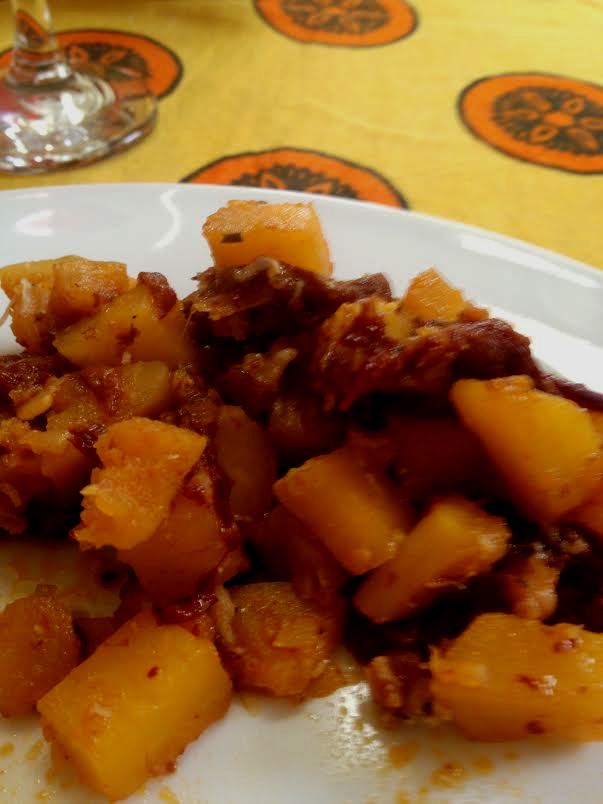
Choose a pan big enough to hold everything. Brown the meatballs in one tablespoon of olive oil, remove and set aside. In the same pan add the rest of the oil, the garlic and rosemary. When the garlic has softened add the chopped Rapa and fry on medium, stirring until well covered with the oil. Add hot stock, cover and simmer on medium / low heat until the Rapa has softened. Do not cook too long, as you don’t want mush. Add the pepperoni, stir and heat through. Add the meatballs, stir and heat through. Serve very hot. Some people will have bread with this, but we found we did not need anything more.

RECIPE (Mr BYF)  – RAPA  ALLA  FRIULANA  (adapted from Carluccio)

As most of the Southern Italians consider Rapa to be cattle feed, the predominant recipes for this vegetable are from the North. This recipe from Friuli is very easy and tasty.

Take a heavy cast iron pot and ad 20 gram of castor sugar and 100 gram of butter

Heat the butter and sugar and allow to caramalise a bit

Now peel and dice one average size Rapa and place in the cast iron pot with the butter and sugar. Stir and cook for about ten  minutes

Ad 50 ml of good white wine vinegar, 20 gram of plain flour and stir gently while gradually adding 250 ml of chicken stock

Adjust for salt and pepper and cook slowly until the Rapa is soft

Serve hot with any meat dish

Do not forget the home made wine

ENJOY!!!

2015-08-17 - Rapa 3