Passata di Pomodoro

2014-11-27 - Passata 12014-11-27 - Passata 2

No good Italian can live without tomatoes, and plenty of it. So the annual Passata day always takes effect when tomatoes are in abundance, ripe, sweet and fresh. Making about 60 kilograms of Passata every year for our own needs, and some as gifts, has been a family tradition for many decades. It helps to be on a good footing with the local green grocer who is only too pleased to discount  the tomatoes that would be considered over ripe in New Zealand, but just right in Italy.

RECIPE

Wash and roughly cut up the tomatoes, and at the same time remove the odd bad or discolored spots. Now boil the tomatoes, without water, for about five to ten minutes, depending on the ripeness, until soft, but not cooked.

2014-11-27 - Passata 62014-11-27 - Passata 82014-11-27 - Passata 9

Passata making can be a huge job without the magical Passata Machine – a device that separates the skin and seeds from the flesh. This little machine can do in excess of 100 kilograms per hour and is wonderfully designed, easy to operate, durable and very quick to clean. No self respecting Italian household is without one! Within minutes I had processed 30 kilograms of tomatoes into 28.5 kilograms of Passata leaving 1.5  kilograms of seeds and skins to compost, or dry to plant next year.

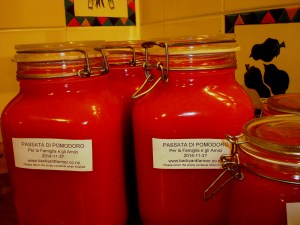
Bottle the tomatoes in clean canning bottles – do not use the cheap screw on type of bottles, but a good strong bottle with lid that can seal properly. There is  no need to sterilise the clean bottles before hand, as it is going to happen after filling them. Put the filled and sealed bottles in a large enough pot that would totally cover the bottles when filled with water. It is good to have a tea towel or some screen in the bottom of the pot, so that the bottles do not stand directly on the heated surface. Now fill the pot with water of about the same temperature as the product is at this stage (prevent bottles from cracking).  Heat until the water is boiling and then boil for twenty minutes more. Immediately remove the bottles from the boiling water, if the water starts to cool, water may be sucked  into the product.
DSC03861

Cool and label.  PRONTO !!

2014-11-27 - Passata 4

While washing the tomatoes, select the ripest and firmest tomatoes for Bruschetta with tomato, basil, olive oil, salt, pepper and garlic. Mrs BYF cannot be beaten for making the best Bruschetta!  ENJOY!

Marinated Fresh Olives

2014-06-12 12.44.502014-06-12 13.41.33-22014-06-12 14.48.222014-06-12 15.36.02

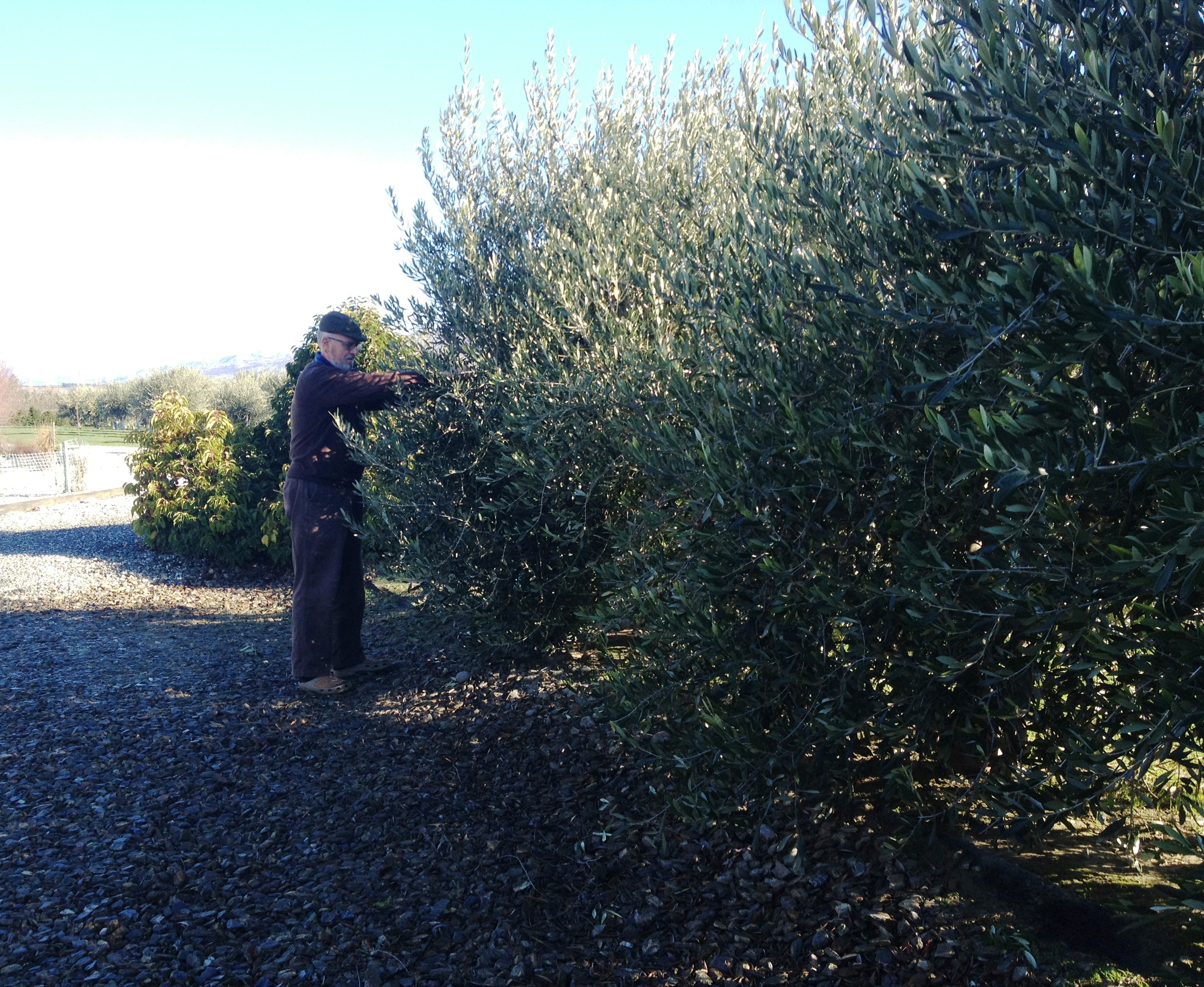
We love olives but are wary of the chemically saturated commercial products available. The solution is to cure our own the way it had been done traditionally in Italy. On the drive to Cromwell to collect olives we passed through beautiful, and often contrasting scenery, as one does when travelling in New Zealand.   We stopped several times to admire the amazingly blue Clutha River. Normally rivers are colored muddy brown and the color and clarity of this river was quite thrilling. Then we passed by Cromwell where we once again stopped to look at the reflections of the mountains (one snowy peak in the background) in the water.  In the distance tantalising, snow covered, mountains stayed just out of reach for close up pictures. The olive grove belongs to Bill and Helen Dunbar and is on  the shores of Lake Dunstan.  The lake and the snowy mountain tops are visible from everywhere, from the cleverly  laid out open plan  house and presses, to the trees when one is picking. The business markets fresh pressed olive oil which, once we got home, we compared with our favorite imported Italian brand and we are happy to report that it came out tops. There is much to be said for a fresh olive oil from good olives and carefully pressed and bottled. See the website http://www.Dunfordgrove.com


2014-06-12 13.31.222014-06-15 14.54.33

Bill and Helen invited me to pick my own olives – an unexpected bonus! The last time I had the opportunity to pick olives was in Italy in the Marche on the farm of an old friend, and then again in my friend Lino’s back yard (one tree only, but what a harvest!).  We picked about 60 Kg, a mix of eating and pressing olives  – thank you Bill and Helen.

Recipe for Curing Olives 

The olives I picked were Picholine, Frantoio and Leccino. Leccino and Frantoio cultivars are the principal raw material for Italian olive oils from Tuscany. Leccino has a mild sweet flavor.  Picholine is grown in Southern France and is a green, medium size, eating olive with a nutty flavor. I am going to cure them all for eating purposes and will try a few different recipes to make it all more interesting.

Picholine –  I have about 40 kg of Picholine and will make 15 Kg in the following way.

Wash and submerge olives in clean cold water with lemon juice of two lemons as well as the lemon peels. Replace the water and lemon every day for five days. Now crush the olives with the bottom of a bottle, but do not destruct the fruit. Submerge again in clean water with lemon juice and peels and again replace water and lemon every day for five days. Drain the water well and pack the olives in glass containers. Ad a quarter of a sliced lemon and one crushed garlic clove per 5 liters. Make enough brine solution of 100 g salt per liter of water to cover all the olives. Bring the brine to a boil, let it cool for five minutes only and then pour the hot brine over the olives. Make sure all the olives are covered. I have plastic grids that fit tightly into the bottles and these keep all the fruit under water. Now add a thin layer of olive oil to seal the product and immediately seal the jars tightly. Store in a cool  dark place for three months before consuming.

Apricot Tart in Winter

2014-06-02 17.14.59

We had a glut of lovely apricots during summer (not from the garden, but from a local farmer) and I preserved quite a few for use during winter. Yesterday I used some of my stash for a pie and got a thumbs up from the household, even from the grand kids who, as a rule, do NOT touch their lips to any “new” foods.

Winter Apricot Tart

Preheat the oven to 200 degrees

Any sweet pastry recipe will do for the case.  I make a  short crust pastry dough without eggs, using butter, sugar and flour, baked until golden.  Line a  300 X 60 mm round spring form cake tin, you can also use a  pie dish (in my case) and press the moist dough up the sides of the tin and pat down the rest of the dough on the base. Add the filling when the crust is cooled slightly.

Filling

500 g preserved apricots

225 g sugar

225 g butter

100 g flour

4 eggs whisked

orange zest

1 orange juiced

vanilla essence or vanilla bean paste

Mix everything together well and pour into pastry case. Bake for 40 minutes at 200 degrees. Glaze the tart with  home made apricot jam

I am going to try the same recipe using preserved pumpkin, in place of the apricot, next week.


Preserved Fruit

2014-06-02 20.31.00

With a glut of fresh fruit available during summer I try to preserve as much as possible for the winter months. Space is at a premium so I do not have room for lots of canned or frozen goods. The best way for me to solve the problem is to vacuum seal the fresh cleaned fruit and then to pasteurise the pouches in a hot water bath.  Different products are processed at temperatures and times specific for the product. After pasteurisation the sealed items should stay fresh in the pantry for a few seasons, although we use everything in winter and start again in summer!

Fave e Cicoria (Broadbeans with Chicory)

2014-05-16 Fave e Chicoria 2014-05-16 - Preserved Fava


I heard about this recipe many years ago but have never tried it. Today I harvested all the chicory in the garden, cleaned it and put it in the pot straight away. I used some of the broadbeans that I had vacuum sealed and preserved during the summer. The result was delicious! The recipe originated in the old Queen of the Sea, Bari (Puglia),  the home town of my dear friend Lino Pansini. I must remember to ask him if his mum ever made it. It is traditionally served in on big plate, placed in the centre of the table, and each person was given a fork.

Fave e Cicoria

500g Broad Beans-  Soaked overnight and boiled down to a puree. I have used my fresh preserved beans (In Italy dried broadbeans are used)

1 Large bunch of fresh green Chicory

A pinch of Chili

2 Cloves of Garlic finely chopped

Olive oil for frying and Extra Virgin Olive Oil for drizzling on the finished dish

Salt and pepper


Cook the broadbeans until most of it becomes a puree, about 40 minutes. Add a bit of salt and pepper to the bean puree. Meantime, boil the chicory for about 10 minutes until tender. Do not add salt to the chicory. Fry the garlic in a bit of olive oil until soft, add the chilli  and chicory (squeese out as much water as you can first). Cook for about 5 minutes. To serve put the chicory on a serving plate and spoon the hot bean puree over the chicory.

This is enough for 4 people as a side and for 2 people if eaten as a main with bread. Use any left over bean puree as a pasta sauce.  ENJOY!