12 Bits and Pieces Vegetable Lunch

Today we needed a quick light lunch. I have come to the conclusion that the more vegetables I bring in from the garden, the more innovative Mrs BYF becomes. I decided to post this recipe that can never be repeated because it was delicious and used up all the bits and pieces I have produced and harvested.

1/2   cup thinly sliced swede
4     handfuls radish tops, washed and picked. Discard the bigger stems and eat the radishes
8   small tomatoes some not fully ripe, some over ripe
2   handfuls of very tiny potatoes
4   very small zucchini and whatever flowers are left, diced
1   small but evil chilli
1  thumb nail sized bit of fresh ginger
1/2  medium onion
1   tablespoon or much more chopped garlic
 4  tablespoons of olive oil
salt and pepper
1  sprig of rosemary just because I got it for free from the museum foyer on Anzac Day
3 fried quail eggs (runny yolk) on top of each serve. The egg is optional but makes all the difference according to Mrs BYF who can eat eggs for every meal, every day of the week
Method
Put the washed radish tops in a pot , cover and fry until the leaves have wilted. In the mean time, fry the onion until translucent in the olive oil along with the garlic, chilli, ginger and rosemary.  When the onion is ready add the potatoes (boil them first if they are bigger than your pinky nail)  and the swede. Fry quickly until all is soft and integrated. Add a spoonful of water if necessary. Lastly, add the tomatoes and fry for a minute. Serve when everything is soft and just before the tomatoes burst. Add salt and pepper to taste.
Add a ladle of Extra Virgin Olive Oil and cracked Black Pepper and enjoy while washing it all down with a glass, or two, of home made Cherry and Black Current Wine. Scoop up the sauce with home made bread.

Garden of Eden

3BFAAC61-295B-4A31-B44D-E4A7B96E7522.jpeg

Only a portion of today’s harvest

The hot and wet summer of Dunedin this year, combined with good healthy soils which we are achieving after four years of constant organic soil development, have changed our garden into the Garden of (Dun)Edin.  Pumpkins and Potatoes, which are both in abundance, are being stored in a dry and dark place to be enjoyed throughout the year.


Today’s Harvest

It is such a pleasure to see these very positive results after four years of hard work developing healthy soils, starting with clay, plastic covering and pebbles (something the previous owners thought you require in a garden), to producing wonderful healthy and fresh organic food.72691908-761A-4F8A-B213-96C52E9776DC

Lepre al Limone di Domenico

B30C60D0-B8CD-4D73-8648-37F35AFF086A.jpeg

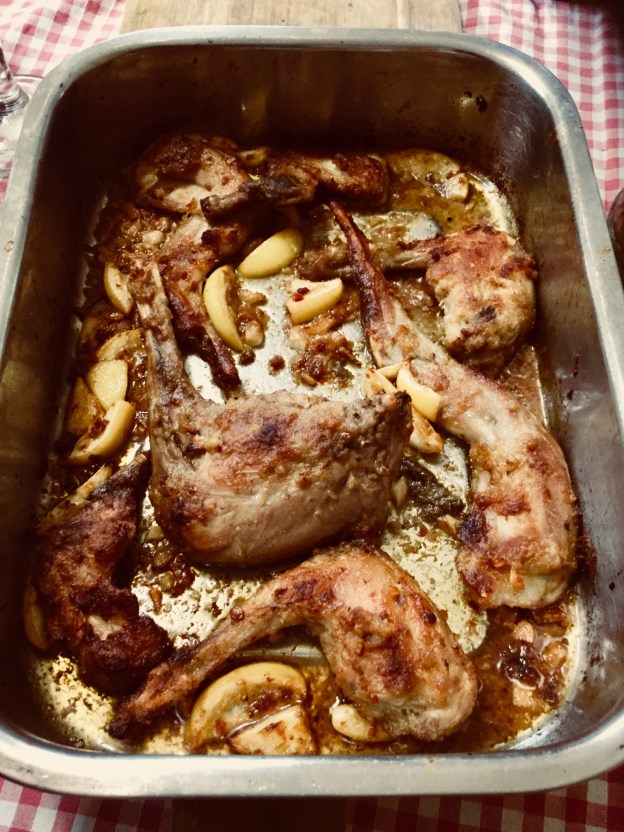
We decided to take a few hares before the newly released virus gets to them. After cleaning them well and ageing in the fridge for some days, it was time to taste.

Lepre al Limone ( Rabbit with Lemon )

  • 1 Hare
  • Half a cup of flour
  • Pinch of salt and pepper
  • Three tablespoons of good Extra Virgin Olive Oil
  • Two table spoons of butter
  • One handful of garlic
  • One fresh hot chili
  • 2 Small fresh lemons
  • Good stock
  • Heat the oven to 200 C.

Cut the rabbit into portions and dry very well with paper napkins. Mix the flour, salt and pepper and dust the rabbit very well. Heat a cast iron or heavy based pan that can fit all the rabbit pieces, add two table spoons of good olive oil, shake off the flour and fry the rabbit until well browned.  When the rabbit is golden, transfer the the pieces to a roasting pan. Add one tablespoon of butter and place in the centre  the oven. Discard the contents of the frying pan and wipe clean. While the rabbit is roasting in the oven,  add one table spoon of butter and one tablespoon of  olive oil to the cleaned pan. Add a handful of fresh garlic and as much chili as you can take,  some whole fresh lemons cut into pieces (I was fortunate to have harvested some small sweet lemons from my tree the day before) and cook on low heat until the garlic is translucent before adding the contents of the pan to the hare in the roasting pan.  Baste and turn the hare often and keep moist with good stock – about a spoon full  at a time, adding stock when the hare appears too dry.  Don’t add too much stock at a time, you never want to poach the hare    (again I had very good stock on hand from pigeons I cooked the day before). Depending on the age of the hares it may take  up to an hour before they are tender, but remember to keep it moist and toss frequently.

Enjoy with your favorite starch (we had potatoes and spinach from the garden)

Never forget the good home made wine. I tried the new cherry wine for the first time and Mrs BYF the new Rhubarb wine.

ENJOY!!!!


Quail Breeding in Italia

OLYMPUS DIGITAL CAMERA

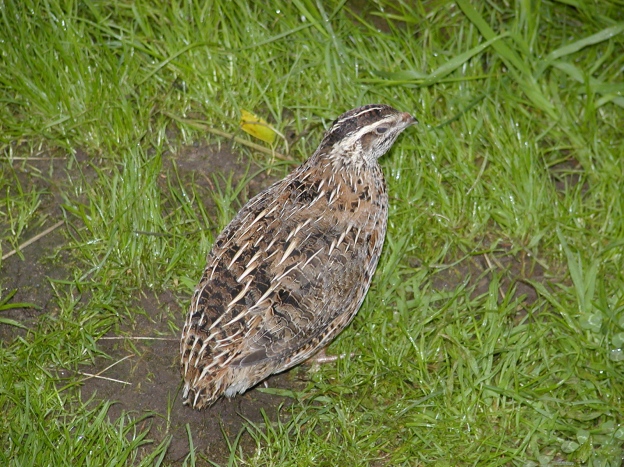
There are many quail and pheasant breeding farms in Italia which all breed for release as hunting is still very popular. It is almost impossible to visit these farms for quarantine reasons as well as keeping the secrets and knowledge within the family. I managed to visit a farm through a contact I had who had a friend that knew the second cousin of the neighboring farmer’s daughter to the quail farm I visited. Even with my good contacts, I still was not allowed inside the cages, but gained enough information. This farm breeds Coturnix coturnix as they still appear in Europe and North Africa in the wild. The birds are small and only weigh about 130 g at maturity. There is a general concern among breeders that some breeders may cross the natural occurring birds with domesticated birds which definitely result in a bird much less adapted to local conditions and also have poor survival capabilities when released. The crossbreeds are a bit heavier and a much inferior flier.

All the following figures are rough estimates, but I think very close to reality. This specific farm sells about 250,000 live quails a year at €1.50 each. For this he has 1,300 breeding hens and 450 males producing 1,000 viable good eggs per day.  He has 6 incubators that takes 3,500 eggs each and fills two of these every week. At 14 days the eggs are transferred to a Hatcher where about 5,600 chicks hatch every week, of which 5,000 grow to eight weeks of age when they are sold for release.

The interesting thing is that his Incubators run at 80% humidity and the Hatcher’s at 90%, which I thought are way too high, but apparently it works that way as I witnessed these levels personally.

The other interesting fact is that the growing cages are sheds with only canvas sides with holes in so the quails can come and go and fly in the adjacent aviaries if they wish. The quails are in these semi open cages from day one.  Gas heaters keep the temperature at about 37C at ground level for the first four weeks. There after the temperature is slowly reduced to day temperature over about one to two weeks, depending on outside temperatures, to harden them up. It gets very cold and it was – 12C on the day I was there and the quails seemed to be happy – my quails would have been dead after the first day. The growing houses are all the same size of 10 X 20 meters each, with two aviaries of 20 X 20 meters each attached to the  sides of each house. Each house holds half of the 5,600 day old chicks.

I was glad to have visited this successful third generation family business which is at present operated by the grandson only as the grandfather is retired and the father attends to the rest of the farm.