 “
“
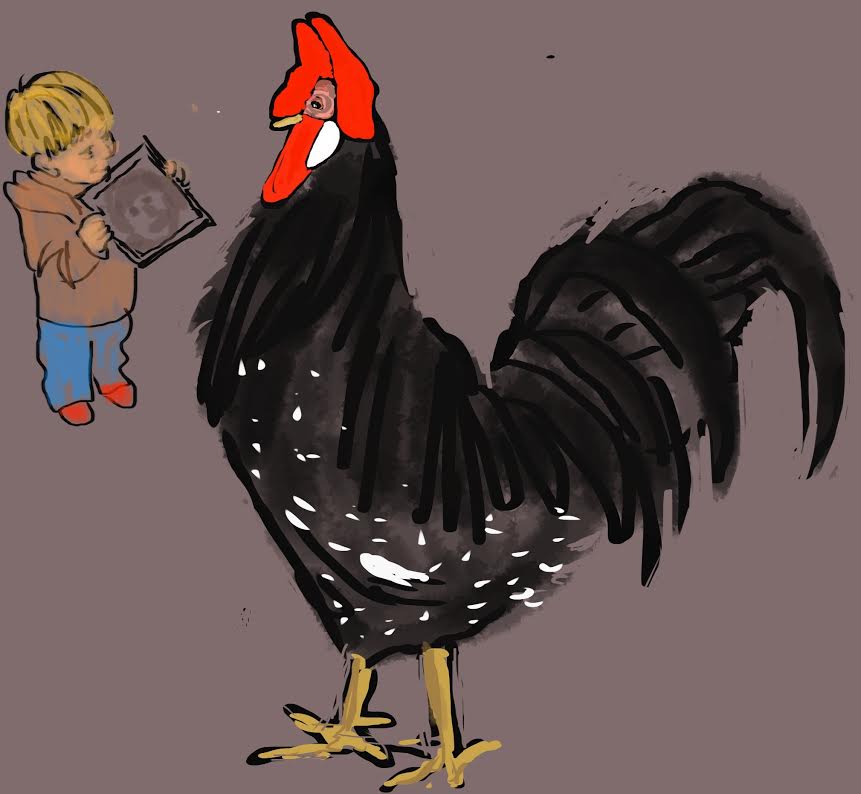
Every feather in place, ready to Skype with great grandma “
“
Every feather in place, ready to Skype with great grandma “
Today was another family outing to the dairy farm and the youngest was keen to get to know the young Jersey bull a lot better by poking and pulling ears of the young future stud.
After having a good look to see if there were any buffalo around, as it was my intention to make some Mozzarella, I had to settle on Jersey milk after all.
We came home with some beautiful fresh full cream Jersey milk, of which I converted the bulk into some fine Brie and Mozzarella. The rest of the milk I put into my home made Separator to collect the rich and yellow cream tomorrow for our week’s supply. Tonight after supper I am converting the whey into Ricotta. We had a delightful antipasto of INSALATA CAPRESE, with fresh home made Mozzarella, fresh ripe tomato, fresh basil, olive oil and pepper, with fresh home made bread to clean out the plate.

MOZZARELLA RECIPE
Heat 10 Liters milk to 33 C and wait until the pH is 6.8. Ad 100 g of thermophyllic mother starter and mix well. Ad 3 g lipase and stir very well. For Jersey milk, top stir for another minute. Cover and ripen at 33 C for 30 minutes. Ad 4 ml rennet and stir with a up and down motion for one minute.. Cover and let is set at 33 C for 90 minutes, or until the milk has set into a soft curd. Once set it will have the texture of a soft yogurt. Gently cut the curd into 6 mm blocks and let it set undisturbed for 20 minutes. The whey will float to the top and the pH should now be 6.5, if it is not, wait a bit longer. Slowly heat the curd t0 38C , increase heat by 2 degrees every 5 minutes. Let it rest for 5 minutes. Drain the whey from the curds (save the whey for Ricotta) Fill a large pot with water (double cooker) and heat water to 40C. Now place the curd pot into the water pot and keep it at 40 C for three hours so the curds can acidify. Every half hour, drain off the whey and flip over the curds. At the end of the three hours check that the pH is 5.2 – 5.3, if not, wait some more. Now put the curd mass on a draining board and cut the curds in 10 mm sizes. Once cut up and drained, put the curds into a stainless steel bowl and cover with water at 78 C. Using two wood spoons, work the curd together and form it into balls. The surface will now become glossy and stretchy. when gently pulled. Continue to work the curd mass until blisters start forming on the surface. When the ph is 5.3 or less, put the cheese into a bowl with cool water to become firm. Make a brine with 5 Liters of water, 1 Kg cheese salt and 20 g Calcium Chloride and submerge the cheese for one hour. It can either be eaten fresh or stored for later use to make delicious pizza.

They say Christmas comes but once a year, mine came on the 8 th of May this year and I am all happy about it. Two of my many weaknesses are 1. The love of glass bottles and 2. Enjoyment of a good auction. I think these traits are hereditary as my Grandfather once waved at a friend across the auction floor, which resulted in him buying 500 pairs of shoes. (Needless to say we were the only kids in school that sported a new pair of shoes every day – it was irrelevant whether these were from an era before Granddad was born or that it did not always fit that well). Today on my way back from Bunnings, my eye caught a sign that said “AUCTION” and since I still needed a couple of hinges and latches for the new chicken extension, I though it good to have a look. Registering as purchaser No 342, I was sure with that many buyers, bargains would be few and far between. I wondered through the isles, but did not see any worthwhile building materials I needed. What I did see was some very nice 2 Liter chemical bottles, used in a past life for concentrated sulphuric acid. The quality of the German made bottles and closures was excellent and all complete with bottles and seals made in a way that only Germany could make to keep sulphuric acid. Arguing with myself that the wine store down the road sells inferior quality 4.5 Liter wine jars with doubtful lids for $17, and I need containers for my wine, beer and vinegar productions, I am going to hang around and maybe I would get lucky and purchase the 50 bottles at $4 – $5 per bottle – a great bargain. The auction progressed well and fast with the lot before the bottles being garden equipment and included at least three very good and long power cords, lots of bolts and screws, two secateurs (German made) branch cutters, an esky, an almost new garden blower / vacuum machine and many more garden stuff – it even had a few latches and hinges. As I did not need most of the stuff, I did not place a bid, nor waved at any friends. The auctioneer at this stage was becoming agitated as nobody wanted to place a bid. Frustrated he moved onto the next lot – the bottles – and announced that the previous lot for which he received no bid would be thrown into the bottle lot. I was disappointing as this move complicated matters gravely. He started at $300 with nobody even looking at him, came down in $10 increments until he reached $100, and still every body was more interested in the cup of coffee they were drinking. I was tempted to jump in at $100 (only $2 per bottle plus all the extras) but resisted. The auctioneer came down all the time asking for a bid, and at $20 shouted that if anybody wants it to please speak up or we shall move on. I put my hand up and said $10 for the lot, he sighed, shook his head, waited for a minute in frustration and started the auction – still nobody moved and he then SOLD it to me for $10 the lot. Christmas comes but once a year – Glass bottles on auction at a give away price.

Today I started making a batch of about 23 Liters (32 bottles of wine) of a blackcurrant and apple rose wine. It is the intention to ferment all the sugars and produce a dry Rose. The juice was extracted from the fruit, filtered and purified with potassium metabisulphite and then fermented, not on must, but directly with the juice. The PH was adjusted to 3.1 by adding a combination of citric and tartaric acids, using the titration method to determine PH as it is more accurate. After measuring the specific gravity with a hydrometer, it was adjusted to a level of 1090 by adding sugar, which, if all fermented, should produce a wine of about 12 % alcohol. Starting with 2 to 3 liters more than the main vat can take gives you product to top up with, from time to time, after racking and filtering. This smaller quantity is fermented in a separate smaller jar (5 Liters) until used. Red wine yeast and nutrients were added and fermentation traps fitted and the long process of fermenting, racking, clearing and filtering started, to hopefully bottle in about four months time when the specific gravity has reached a level of less than 1000. I rack and filter more frequent than normal, as I like a clear clean drinking wine. This should be a very palatable dry table wine, light red or rose in colour with very little sweetness, a good nose, clean taste and medium body, which is the way I like my lunch time wine.


About 30 years ago my mother made me a coffee table. It turned out to be magnificent and was to be one of several made by her. It had later traveled to Australia (I packed it personally), it moved about to several rental properties before we bought a house, and then it survived another voyage to New Zealand. It is rather fragile and it is a miracle that it survived all the moves. It has also been used as a play surface by the grand kids, one who learnt to walk by holding on and going round and round. The baby also produces copious amounts of drool since he is teething and manages to drool under the glass top (another miracle), staining the wooden rim. It was looking a bit neglected. I wanted op restore it to its former natural glow but I hate varnish and oils would change the colour so left it alone for years and years. Last week I made some beeswax polish and tested it on a small part of the table – I was delighted with the result. I applied the polish with a dishcloth and buffed it up as I went along and the table looks wonderful. The pictures show the table without the glass top. Another good thing was that the table smelled good and I did not have to have to clean the wax from my hands since it is the same as the cream I put on my face.
My mother was /is an artist and in her nineties now. She went from painting to sculpting, in wood eventually, ending up making bedsteads, doors , tables and huge full length mirrors in wood. The designs were her own and as a child I remember admiring her doodles which covered every bit of paper, the phone book, napkins, every thing that was at hand. This table reminds me of those doodles, always full of curves and swirls and flowers and as I polished, I enjoyed tracing the forms with my cloth and fingers, a three dimensional doodle, almost, a wonderful gift from my mother.
PS – As you can see by the writing style, this was written by Mrs Back Yard Farmer
 Back Yard Farmer