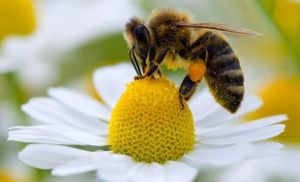
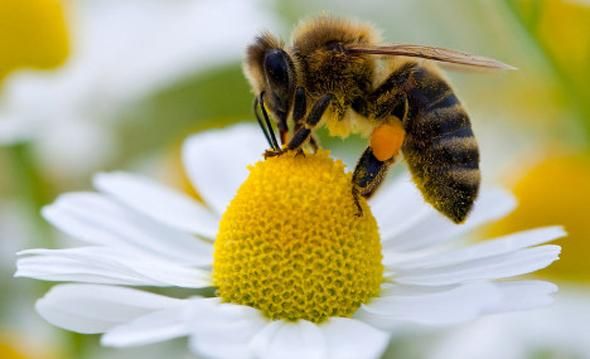
A honeybee who has found a good source of nectar or pollen performs a waggle dance to tell her nestmates where she has foraged. Here she repeatedly communicates that the profitable food location is at approximately 750m from the hive and about 270 degrees from the sun’s azimuth
Honeybees fly much longer distances in the summer than in the spring and autumn to find good sources of food, a new study has found.
Researchers at Sussex University spent two years decoding the “waggle dance” of thousands of honeybees, a form of communication by which the bees tell their nestmates where to go to get the best source of food to bring back to the hive.
By measuring the angle of the dance in relation to the sun and the length of time the bee waggled its abdomen while moving in a figure of eight pattern, researchers have been able to map the distance and location where bees forage from month to month.
With a one second waggle equating to a foraging distance of 750 metres, the bees dance language revealed that the area they covered in search of food is approximately 22 times greater in the summer (July and August) than in spring (March) and six times greater in summer than in the autumn (October). In the summer the area they cover is 15.2km sq, compared to 0.8km in spring and 5.1km in the autumn.
Honeybees will not waste valuable time and energy travelling to find food if they don’t need to, so the researchers say the results, published in the journal PlOS One, show that the summer is the most challenging season for bees to collect the nectar and pollen from flowers.
“There is an abundance of flowers in the spring from crocuses and dandelions to blossoming fruit trees. And in the autumn there is an abundance of flowering ivy. But it is harder for them to locate good patches of flowers in the summer because agricultural intensification means there are fewer wildflowers in the countryside for bees,” said Frances Ratnieks, professor of apiculture at Sussex University, who supervised the study.
Honeybees face many challenges including increasing lack of forage because of modern farming practices.
The researcher say the results can be used to focus efforts to help bees better. “The bees are telling us where they are foraging so we can now understand how best to help them by planting more flowers for them in the summer,” said Ratnieks.This video describes the research project Waggle dance distances as integrative indicators of seasonal foraging challenges carried out by Margaret Couvillon, Roger Schürch and Francis Ratnieks at the Laboratory of Apiculture & Social Insects (LASI) in the School of Life Sciences, University of Sussex
Honeybees may also have to forage further in the summer because they have more mouths to feed when the colony expands to 50,000 bees and there is more competition for food from other insects and pollinators including bumblebees.
The glass-fronted observation hives are located at the university campus surrounded by the South Downs countryside and a few kilometres from the city parks and gardens of nearby Brighton and Hove.
The waggle dance clearly show that the bees are heading to the downs in the summer and researchers are currently examining which flowers they are feeding there.
The honeybee dance language was first decoded by Austrian scientist Karl von Frisch who was awarded a Nobel prize in 1973 for the discovery.
Ratnieks said its work will benefit other pollinators, such as bumblebees.
“Mapping the waggle dance will allow us to help other species, because where honeybees find good food, we have already found a plethora of other pollinating insects feeding there,” said Ratnieks. “So we can improve forage for all these insects.”
The Sussex research comes as the the IUCN’s latest “red list” of threatened species update warns that 24% of Europe’s 68 bumblebee species are threatened with extinction. According to the Status and Trends of European Pollinators, loss of habitat and wildflowers due to modern farming practices and urban development, plus changes in temperature from climate change, are the main threats to the species.
http://pulse.me/s/10CT6z





 Back Yard Farmer