Goatherd’s Lunch

2014-03-10 14.57.572014-03-10 14.58.042014-03-12 10.50.28

Today’s lunch is unusual because nothing was from my garden apart from the apples. In Italy the herders travel  light, climbing up the mountains with their animals carrying  a lunch of cheese, bread, fruit and wine in a bag. I did not travel on foot, but, on my way to get fresh milk I passed the farm of a friend who makes delicious cheese from the milk of her own goats and sheep and brought some home.  All organic of course, from happy sheep and goats, and she learnt her craft in Switzerland so I could not miss. I rushed home, started my ricotta and spread my treasures on the table along with my own bread and apples, and the neighbour’s pears. A true feast!

I took pictures of the stunning scenery on the way there – it was a bit misty but beautiful still – and only about 10 minutes from my house. Dunedin surprises me every day, it certainly is not only a small university city, it has many talented and gifted residents that revel the lifestyle that can only be had in this rather isolated beauty spot.

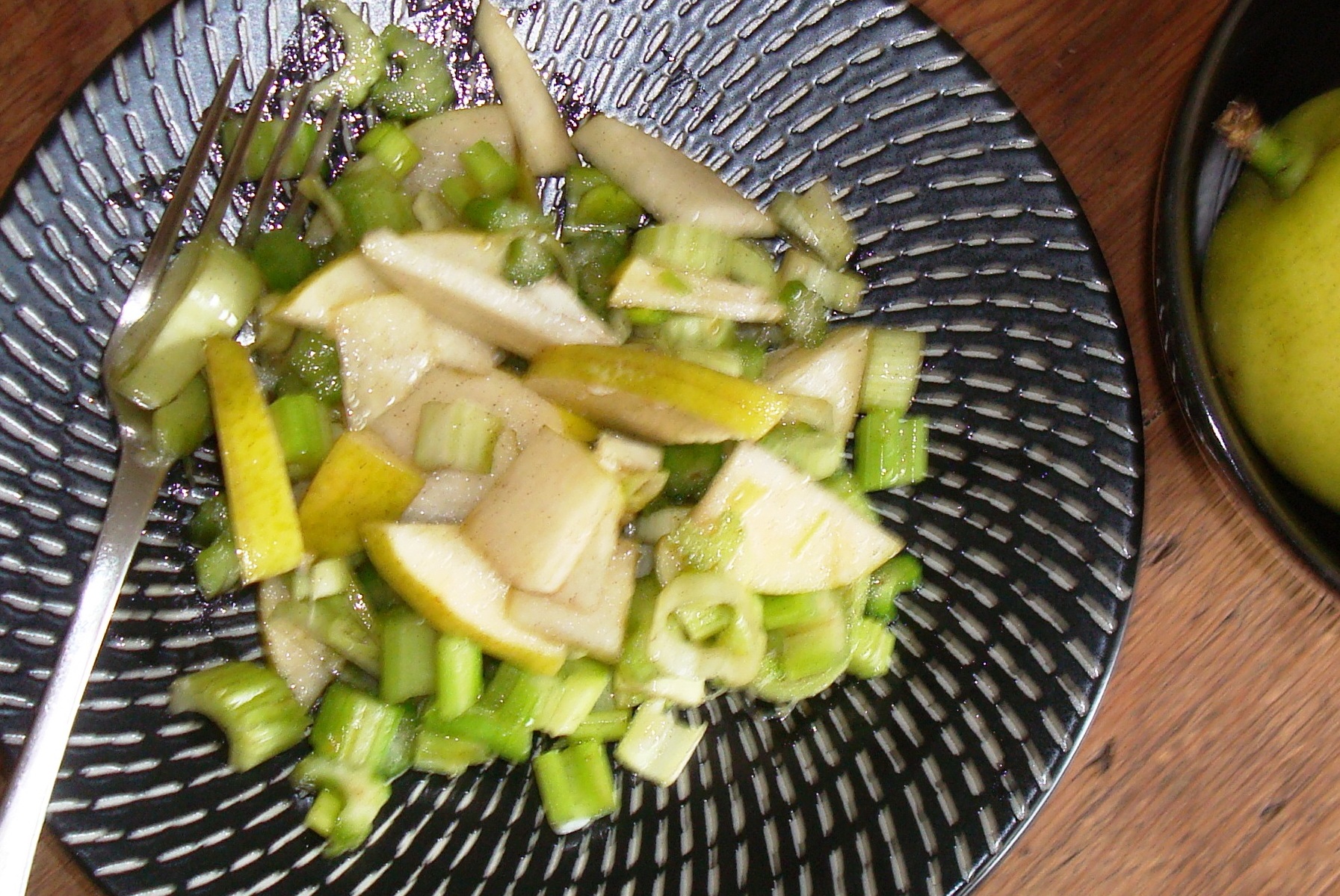
Nashi Pear and Celery Salad

2014-03-02 15.28.42

My generous neighbor has a large established garden with some prolific fruit trees. I got some of his nashi pears as a gift.  I love eating them like one would eat an apple, but for the rest of the family I had to combine the pears with some freshly harvested celery to make  a crunchy salad.  I had to make it again the next day, always a sign that the recipe was a good one!

1 large nashi pear

1/4 head of celery

5 cm of leek

1 1/2 table spoon fruit scrap vinegar

4 table spoons olive oil

salt and pepper

You can add chopped nuts and a bit of strong cheese if you have any on hand

Chop everything up and mix with a dressing made of the vinegar, olive oil, salt and pepper. Serve with fresh bread, and on a hot day, a glass of chilled Prosecco.

Apricot and (Dunedin) Rosemary Jam


2014-02-23 16.10.542014-02-26 12.33.02

I am a bit of a jam tragic, if there is anything in abundance I need to make jam from it (or preserve it one way or another). I have a lot of apricots and Dunedin has a lot of rosemary. There are no genuine Italian food ingredients to be had over here, apart from all this rosemary. It grows in every garden, cascades down garden walls in the university grounds, grows vigorously several public spaces, parks, everywhere but in my garden. Why the inhabitants plant so much of it, I can not fathom, since I can not believe that they cook with it. But, I seem to be the only person in Dunedin who has not succeeded in growing a single sprig.  To get my hands on rosemary I have to resort to theft from lush bushes of the stuff overhanging various pavements around where I live.

Apricot and Rosemary Jam 

3 Kg Ripe Apricots

2 Kg White Sugar

20 g Finely chopped Rosmary leave

15 g Apricot Stone kernels, finely chopped

Cook everything together in a big pot for half an hour. Let it rest for some 12 hours.  Cook again until the jam consistency reaches the “Freezer Test ” thickness. Stir in a tablespoon of butter and take it off the heat. When it is cool enough to handle. bottle and seal. Sterilise the closed bottles as described before.

This flavorsome jam is ideal for eating with strong cheeses and using as a glaze for pork and poultry.

Cherries in Brandy

2014-02-14 17.01.58

I am prepared for the winter when there will be no cherries at all. I shall be drinking the cherry infused brandy and eating the cherries in front of the fire!

Cherries in Brandy

350 g   sugar

1 liter  brandy

Ripe, unblemished cherries, stalks on, washed. stones in

sterilized jars

Dissolve the sugar in the brandy. Cut the end of the cherry stalks off leaving about 1/2 of the stalk on the cherry and prick the cherry with a needle on the opposite side of the stem. Pack the cherries in the jars, ensure that the jars are full enough so that the cherries will not float around later. Pour the brandy mixture in the jars, make sure that all the cherries are covered. Store in a cool dark place for 3 months before eating.

I try very hard but I  always eat mine up long before the 3 months are past and they always taste wonderful!

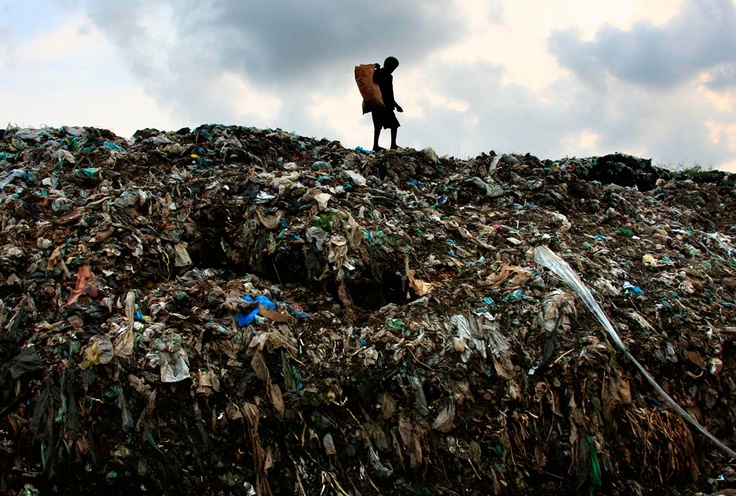
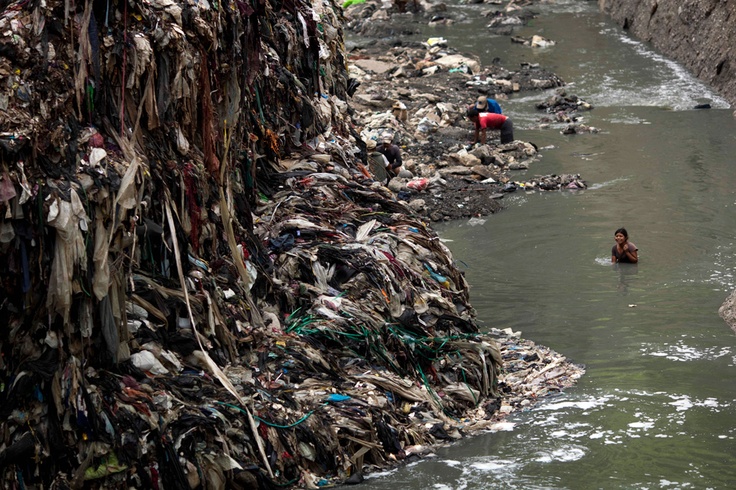
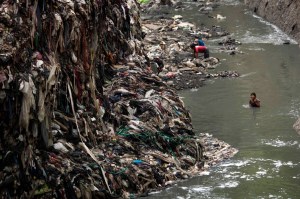
Who needs the Waste?

2014-02-10 - Garbage2014-02-10 - Garbage 3

A WASTE REDUCTION PROGRAME (to be followed by all in New Zealand?)

The Council is supplying households with a YELLOW BIN and a BLUE BIN for paper and glass recycling respectively. Then you could either purchase black rubbish bags or rent a RED BIN for all your rubbish. This is for Dunedin, but probably similar elsewhere.

The object of garbage management in your household should be such that you should strive to have as little as possible to put in THE YELLOW, BLUE and RED BINS at all times. How do you achieve this? Firstly you keep an additional four containers under your sink (I keep 2 litre plastic buckets) and come into the habit when you work in the kitchen to have these bins readily available and sort offal into these in the sequence described underneath, as much as possible.

The BLUE BINS are used for unbroken glass bottles and jars

The YELLOW BINS are for paper and cardboard, clean rigid plastic, tins, cans, aluminium trays, foil, aerosol cans, plastic bottles, containers and lids

The other four bins are :

The GARDEN COMPOST BIN (If you do not make garden, it is now the time to start 😉 ) What goes into this bin?
• Citrus off cuts and peels
• Onion off cuts and skins
• Coffee Grinds
• Tea Bags
• Egg shells
• Newspapers and other light paper materials

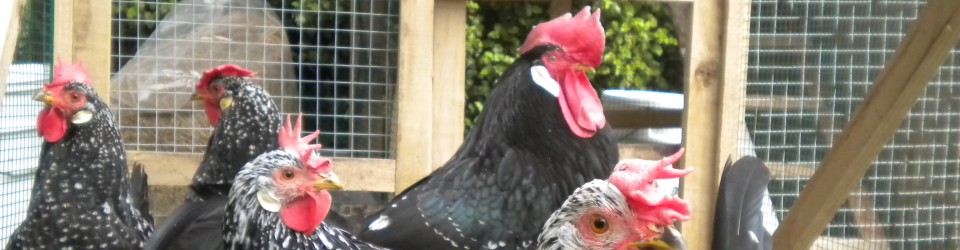
The POULTRY BIN (Chickens are a delight!) – What goes into this bin?
• All off cuts and left overs that a human being will normally eat and benefit from if stranded in the desert and starving. Remember chickens love meat and meat products. Cut these in bite size bits for the chickens, ducks, quails or what ever.

The RABBIT BIN (Bunnies are so cute!) – What goes into this bin?
• The same principle applies as for chickens, but only the vegetarian foods – if you can eat it, so can the rabbits. Depending on rabbit and chicken numbers and animal preferences, divide food between these two groups.

The WORM BIN (Get worms ;-))
• Anything vegetarian that the chickens and rabbits wont eat or do not like, goes to the worms, like banana peels, apple cores, hard or wilted outer leaves of vegetables, poisonous plants for animals like rhubarb leaves, etc. Do not put meat into this bin as it attracts vermin

The GARDEN COMPOST BIN – You should have a compost bin already if you are a gardener
• Any product that will ferment in one to two months if composted and did not fit into any of the above. Do not put meat into this bin as it attracts vermin

The RED RUBBISH BIN – The odd product may go into this, which is unavoidable
• Bones
• Plastic Bags

The idea is to have as little as possible to put into BLUE, YELLOW and RED BINS.

For those of us who are fortunate enough to have a working vegetable and fruit tree garden the problem is so much smaller and easier to handle. Try to buy as little as possible processed, tinned and bottled food – buy fresh and unprocessed if you do not produce it yourself. Should we follow the above simple steps,  vast amounts of money will be saved, the human   carbon footprint will be dramatically reduced  with all the accompanying benefits. Last week was the National Day Against Waste in Italy. A project supported by the worldwide SLOWFOOD organisation.  If it is in Italian, click “TRANSLATE” on the top of the page for English