
Day old Quail Chicks

During the Dunedin Science Festival my eye caught a title while briefing through the program “Quails and Plastic Bottles”. I obviously was immediately interested and booked my ticket for the 1 hour lecture. The talk was a big disappointment as it discussed quails for about 10 seconds, in which some very inaccurate and irrelevant information was conveyed. The talk about plastic bottles, which was not quail related at all, lasted for another 10 seconds. With this in mind, I am giving you another look at Quails and Plastic Bottles. Needless to say that recycling old plastic bottles is the correct thing to do and it makes me tremendously happy to do my bit in limiting the carbon footprint and plastic pollution of our dysfunctional world. The alternative is to purchase some poultry feeders. at exorbitant prices, from companies here in New Zealand that import vast quantities of more Chinese plastics and the irony is that these purchased feeders are by no means so effective as the home made ones.
I use 2 liter used plastic milk bottles to make my quail water drinkers and feeders. Once the quail chicks reach another stage of maturity and size I introduce a new drinker and feeder to suite their needs until fully grown.
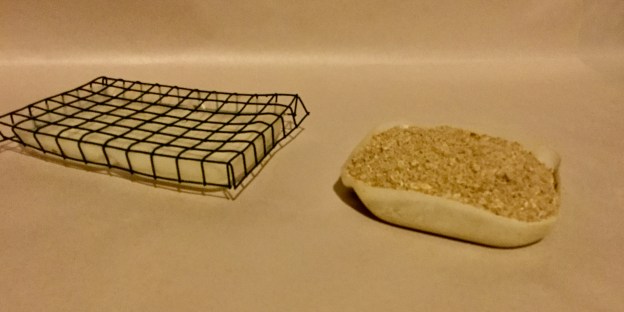
I start off by giving them open feed and water covered by a wire mesh to teach them to eat and drink.

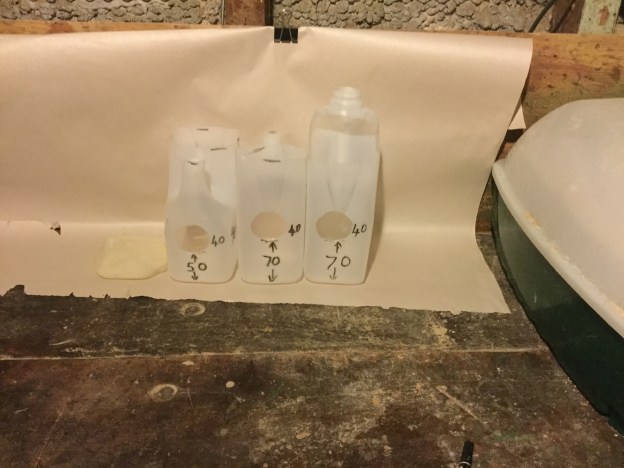
At 7 days of age I introduce the next drinkers and feeders. The water drinker with the 25 mm openings, 50 mm of the ground, on two sides of the bottle (it stands in a corner) allows them to investigate and mostly by accident have their first drink. For the first few hours I drip water in the drinkers from above so the little quails come and investigate the noise and water sound and find themselves drinking by surprise. It only takes them a few hours to be master the water drinkers. It is however important to not have these drinkers before 7 days of age as the little quails are too small and fit through the hole and drown. If the hole is exactly 25 mm and round , not oval, the chicks will not fit through at 7 days of age and you will have 100% success. The feeders have 50 mm holes and the quails can eat from the outside, or get themselves into the bottle and eat inside. This teaches them where the food is and soon enough they will be too big to fit through the hole and only eat from the outside, like the mature quails do.
I cut the tops of the bottles in the beginning stages so they can fit into the brooders which is only 200 mm high. It is important to cut the height such that their is very little space between the top of the drinker and the roof of the brooder so the little quails cannot jump into them, which is a trick they learn early in life.
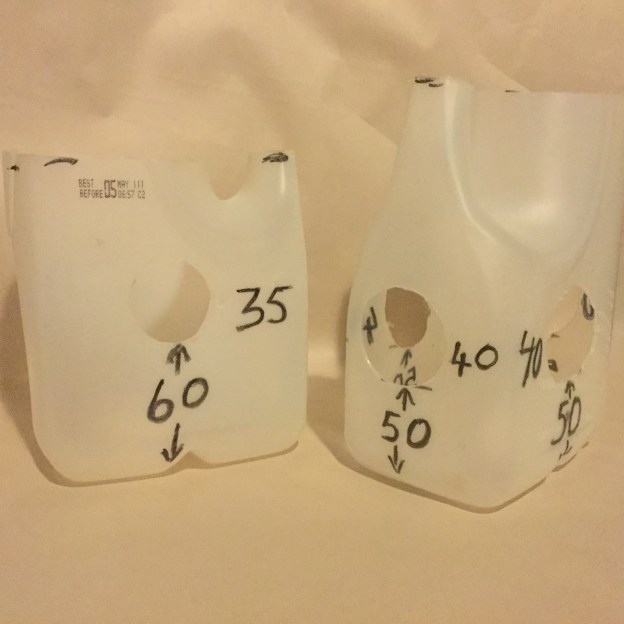
At 14 days of age, I change the water drinkers to a 35 mm hole and 60 mm of the ground as their heads are getting too large for the 25 mm hole. I now also switch to only one water hole which makes it easier to fill to the rim without water flowing out of one of the other holes. Use the 35 mm 70 mm off the ground if the bedding becomes too high. The feeder remains the same.

At 28 days of age I change to adult feeders and drinkers with 40 mm holes and 70 mm off the ground.
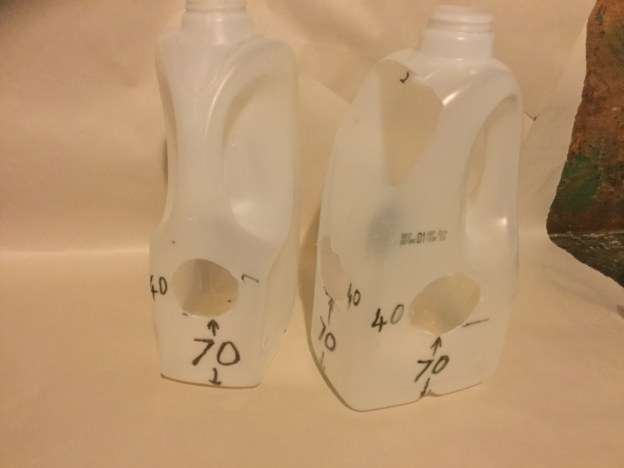
At 49 days of age when I take them from the brooders to the breeding pens outside, they stay on 40 mm holes and 70 mm off the ground, but have a section at the top cut out to make feeding and washing of the feeders easier. I do not top up the feeders, but dump and refill. The water feeders are without the opening to prevent birds landing in the water as my cages are 600 mm high and they can fly and land in the water if open. These feeders hold about two days of feed and water for a breeding group of 5 females and a male which make it easy to go away for a weekend without having to feed.

All the water drinkers you will require
All the feeders you would require
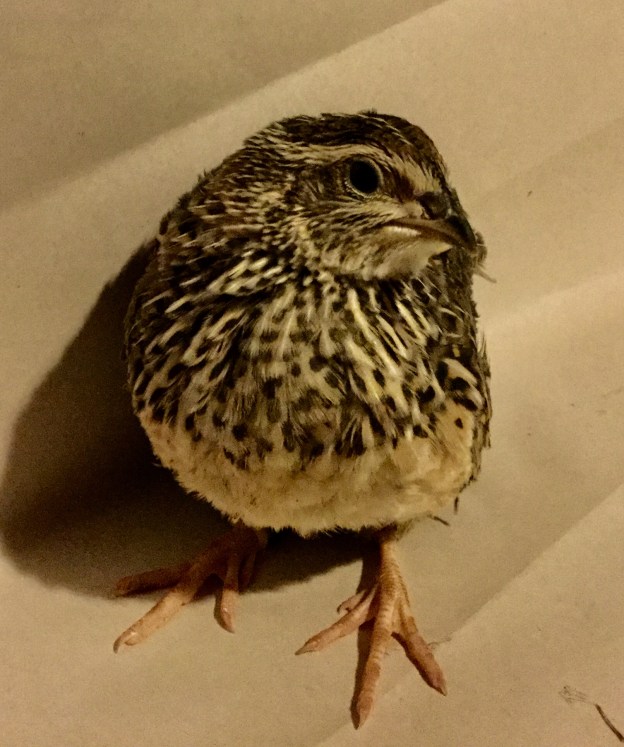
I have been breeding quails for many a year now and was absolutely sure that I know the birds and can colour sex the Pharoah Breed of Coturnix coturnix at the age of four weeks, 100 % successfully. Today I was selecting breeding hens out of a pen of 29 four week old female quails which were all very well marked with black spots and no red / brown feathers on the chests, as I have already separated them in male and female groups at three weeks of age. It is normal procedure for me to handle the birds and on feel and visual appearance select a few more than what I would require and then weigh them as well to assist my final selections. I selected 8 birds as I only needed one group of 6 females for a pen. There was this one female that caught my attention every time I handled or looked at her and when I weighed them, she was, at 220 grams, 24 grams heavier than the next best weighted bird of the selected group. I was overjoyed with this wonderful specimen and ringed her for future identification purposes. I worked through the rest of the birds and ended up with a very handsome group of 6 females. As I was clearing the workbench for the next task I heard a crow from the pen of selected hens and on closer inspection found my prized hen crowing.
This is very confusing as she has perfect hen markings and above all the males are always much lighter than the females. I am going to keep a close look at her / him and whichever way it goes, it will be a special bird. Either a VERY HEAVY male or a CROWING female.
It is in my nature to measure and monitor, which makes life interesting and the only way should you want to select and make progress with any animal breeding. I slaughter about ten old Quail Hens every two weeks and 20+ Young Quails every alternate week and always weigh all animals and carcasses at slaughter. Obviously there are many other measurements and observations I frequently collect and record to assist in selecting that “perfect” bird.
Here are some of the figures I collected over the past week and which are fairly representative for the past six months.
| Mature Birds – g | % | Young Birds – g | % | |
| Live Bird | 294 | 211 | ||
| Carcase 1 | 265 | 90.1 | 193 | 91.5 |
| Carcase 2 | 176 | 60.0 | 138 | 65.4 |

Live Bird – Average live bird mass after food and water were withheld for 12 hours
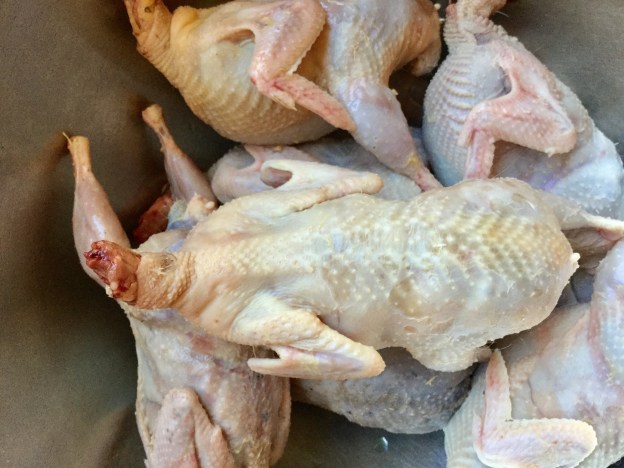
Carcase 1 – Average carcass mass after heads and lower legs were removed and feathers plucked

Carcase 2 – Average carcass mass butterflied, which in my case means the removal of the entire backbone, all internal organs removed, wing tips removed and excess skin trimmed.
After all this lovely Quail Meat you have harvested there is still the Coratella that makes a wonderful meal on its own and Quail Stock which I use in almost all of my daily cooking.

 Back Yard Farmer