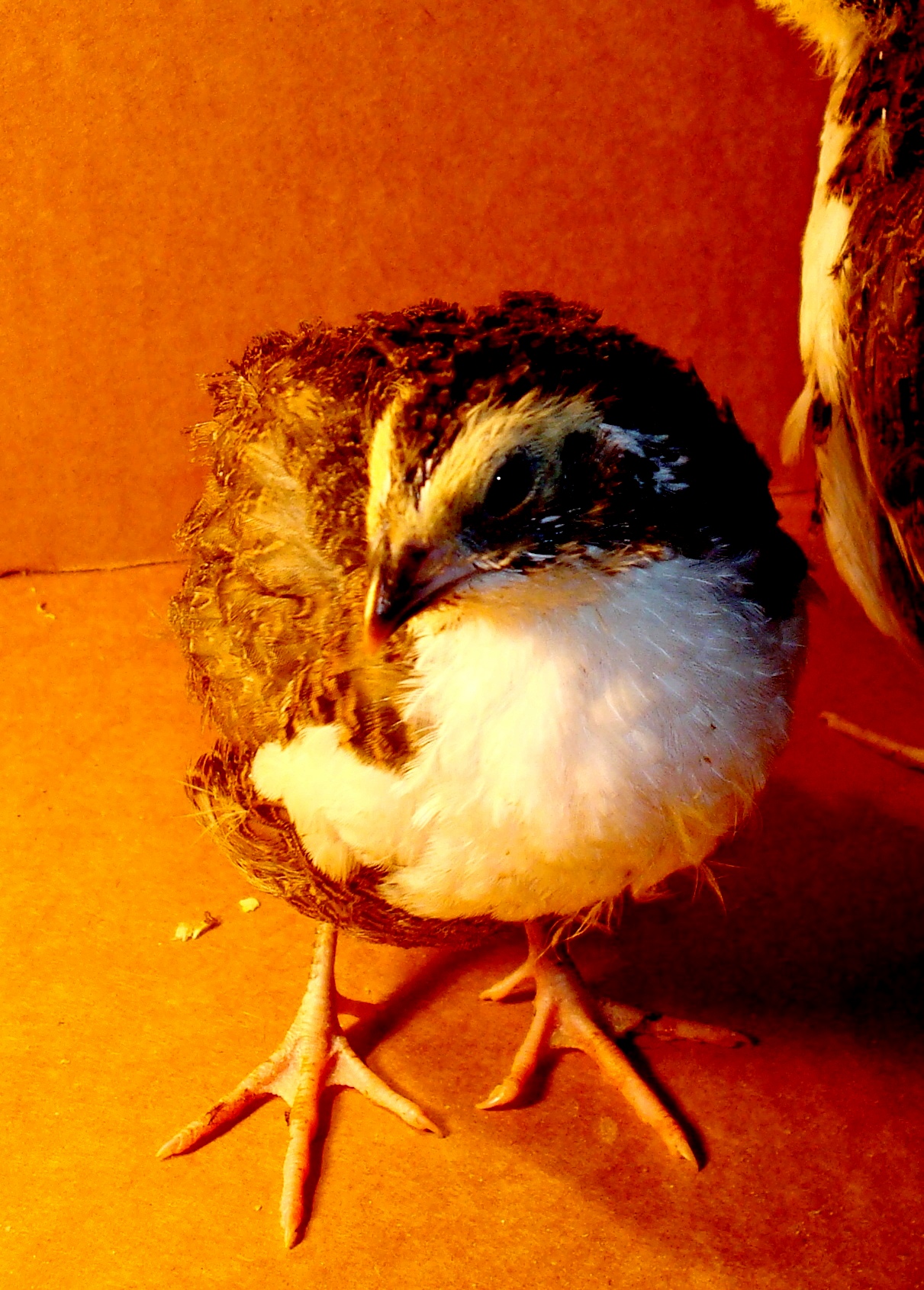
Rare Coturnix coturnix

9

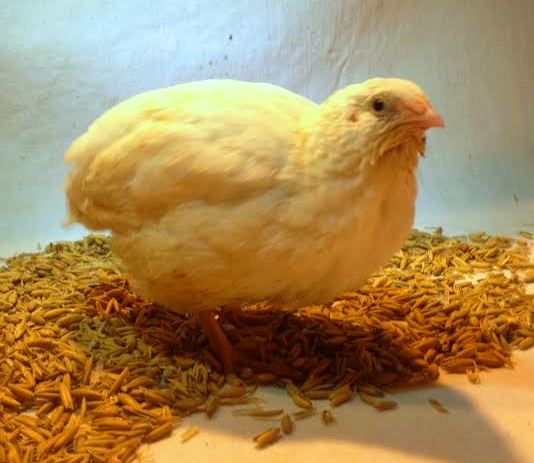
Every so often one finds a unique bird in your flock. At present I am breeding four different breeds of Coturnix coturnix, one which is a White breed that was originally developed by the A & M Texas University as a dual purpose bird. The Americans claim their Jumbo Browns to be 450 – 500 g in body mass, but trying to locate such birds or breeders of these large birds appears to be very difficult – I do not know why the Americans want to hide these. Anyway, unlike our friends from abroad, I am not trying to breed the Coturnix coturnix bigger and bigger (if I wanted to breed big birds, I would have started with ostriches), but have put my mind on breeding two of my breeds to be about 280 – 300 g for the females and 220 – 250 for the males – a milestone I have already reached in New Zealand after two and a half years of intensive selection. Hence, I am presently selecting against too big birds in these breeds and made my primary selection criteria egg production, feed conversion, fecundity and body conformation. This is a good size eating bird, which is still an effective producer of both meat and eggs. But back to my unique bird – the A & M Texans are white, but almost always have a black or brown spot somewhere on the body. It is a breed I have had little experience with, but breeding more than 1200 Whites over the past two years, I have bred only three ALL WHITES with no other coloring at all. The first two did not make it on my selection criteria and color not being important to me, they only made it as far as the stock pot. This third all white I have will definitely make it to the breeding pens as he is a magnificent specimen and weighed in at 230 g on 33 days of age. This is my UNIQUE BIRD! (I presume there are other breeders in New Zealand with strains of the pure whites)


POOR POOR SERVICE !!!

2014-11-22 - Broken Eggs Salama 42014-11-22 - Broken Eggs Salama 22014-11-22 - Broken Eggs Salama 72014-11-22 - Egg Trays Salama 2 2014-11-22 - Egg Trays Salama 4

I want to state that this post is not a reflection on all quail breeders in New Zealand, with whom I hope to maintain a positive relationship, but an isolated, and hopefully, rare case.

I am trying to get more good unrelated quail (Coturnix coturnix) birds to enhance my breeding programs. Lack of available birds, costs and unwillingness of some breeders to work together in my efforts to enhance the quality of the Coturnix coturnix in New Zealand has forced me to buy eggs and hatch with the hope of finding some good birds among them. Needless to say, it is an uphill battle. I am reporting here on one specific “Breeder” that has sent me three batches of eggs. The first batch had a hatching percentage of 0%. In the same machine were eggs from other breeders which have achieved hatching percentages well in excess of 60%. Consignment two is still in the incubator. Consignment three, of 100 eggs, arrived with 52 visually broken eggs and perhaps many more with hairline cracks – 13 of the unbroken eggs were under 8 g in weight (too small to incubate) – All egg yolks are a palish yellow color, pointing towards very unhealthy and underfed birds. The breakages occurred because the sender cut and stacked the egg trays in such a way that each egg tray actually rested on the eggs below, instead of having the trays supporting each other protecting the eggs (see last photo which is an example – the other photos were actual as the eggs were received).  The “Breeder” refuses to reimburse or replace any eggs as he claims that the courier  to be at fault. I have used the same courier for hundreds of egg consignments wit good results.

Quaglia Marinata al Forno

GROWTH AND DRESSING PERCENTAGES
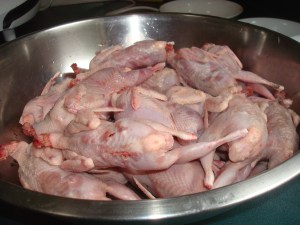
DSC03683DSC03700

I slaughtered another batch of quails today. The law of averages is playing up and a batch of 38 quails produced 29 males and ONLY 9 females. So the bank is empty, but the fridge is full. Being a scientist and engaged in a breeding program endeavoring to improve the Coturnix coturnix in New Zealand, I of coarse monitor many parameters and wish other people would also provide concrete actual results (especially those Americans claiming to grow gigantic everything, which is not always good even though they may be big), so as to be able to monitor and compare progress and set standards. In my egg producing breeds, I am of the opinion that I have reached optimum body size. For the dual purpose breeds, I am still selecting for larger birds and am  making  some definite headway. Here are some results obtained from the last 180 quails slaughtered :

Body mass at 21 days of age (all sexes of all breeds) – 114 g (averages still on the rise)

Body mass at 35 days of age (males of all breeds) –  188 g (averages still on the rise)

As I slaughter on day 35, here are the slaughtering results :

Live mass – 188 g

Dressed mass (back bone out, skin on, wings clipped) – 105 g (56%)

Gizzards, livers, harts, etc – 11 g (6 %)

Stock Meat – Back bone, wings, etc –  34 (18%)

Intestines (Discards) – 10 g (5 %)

Feathers, heads, blood, feet, etc (Discards) – 28 g (15%)

QUAGLIA MARINATO AL FORNO

2013-10-22 - Quaglia con Pancetta, Salvia e Polenta 4

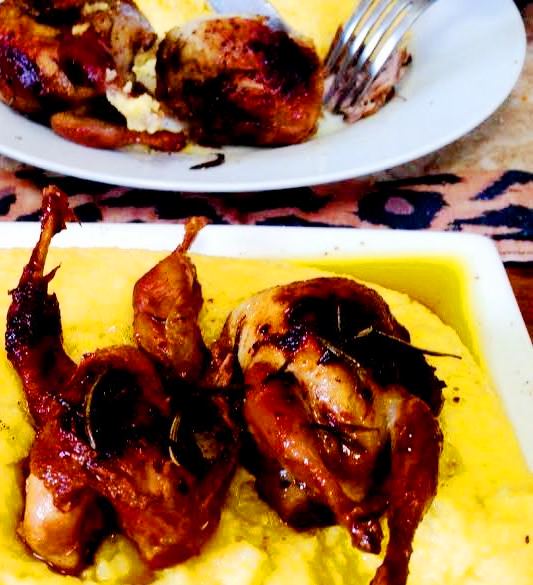
One of my favorite Quail recipes is marinated quails on the coals. Very easy – on slaughtering day, place the quails in a container and add enough olive oil to cover them well inside and out. Now add some salt, pepper, chili, rosemary, oregano, garlic and a few slices of lemon. Those that I do not marinate go straight into maximum vacuumed sealed bags and if consumed within a week, I store them in the fridge only – the rest goes into the freezer, if any. Leave in marinade for one day while turning it over every so often. Grill on a medium to hot fire and as these are young and tender, it only takes a few minutes to do. Serve with polenta and a very good red wine – ENJOY !!


21 Day old Weigh In

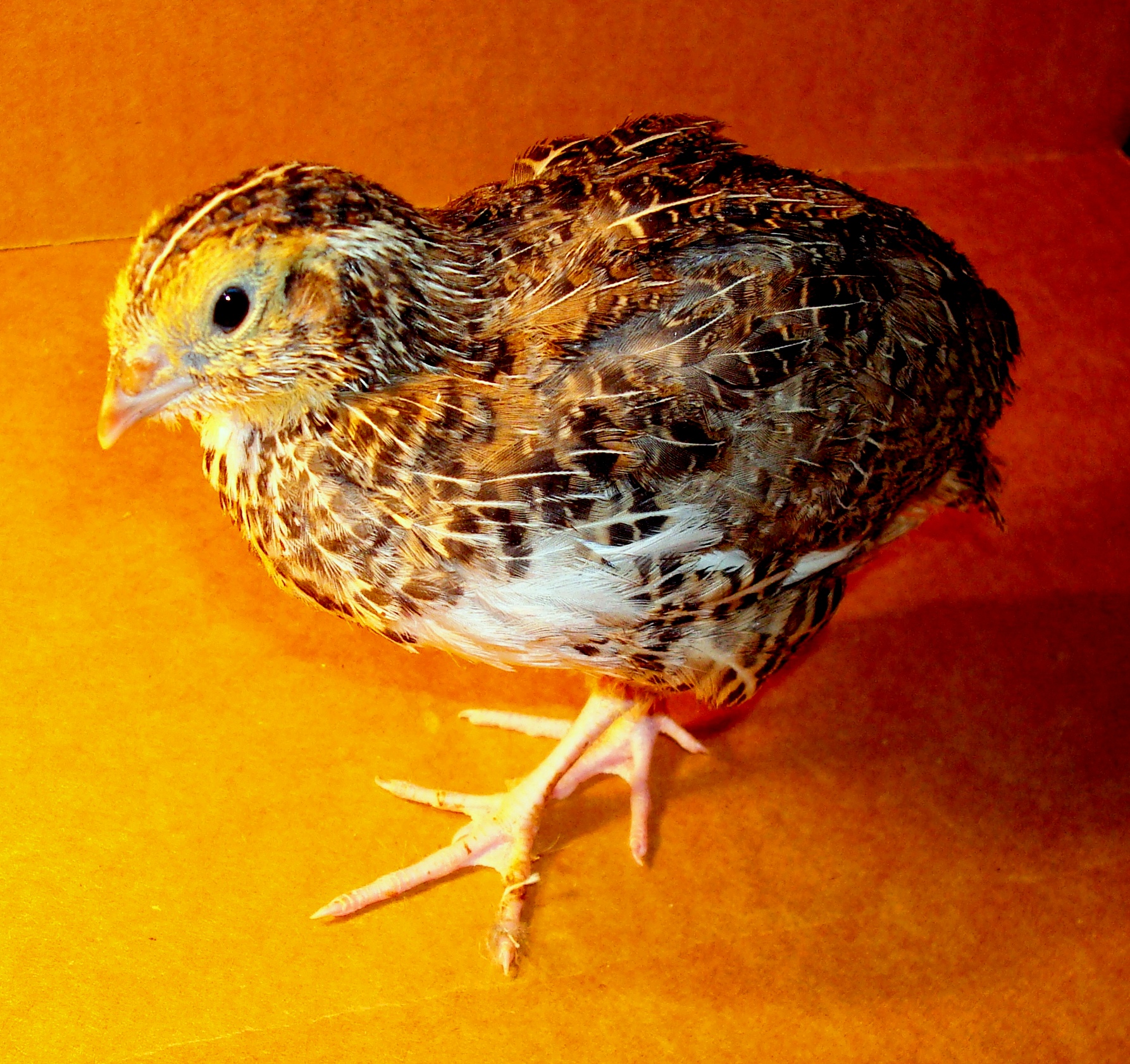
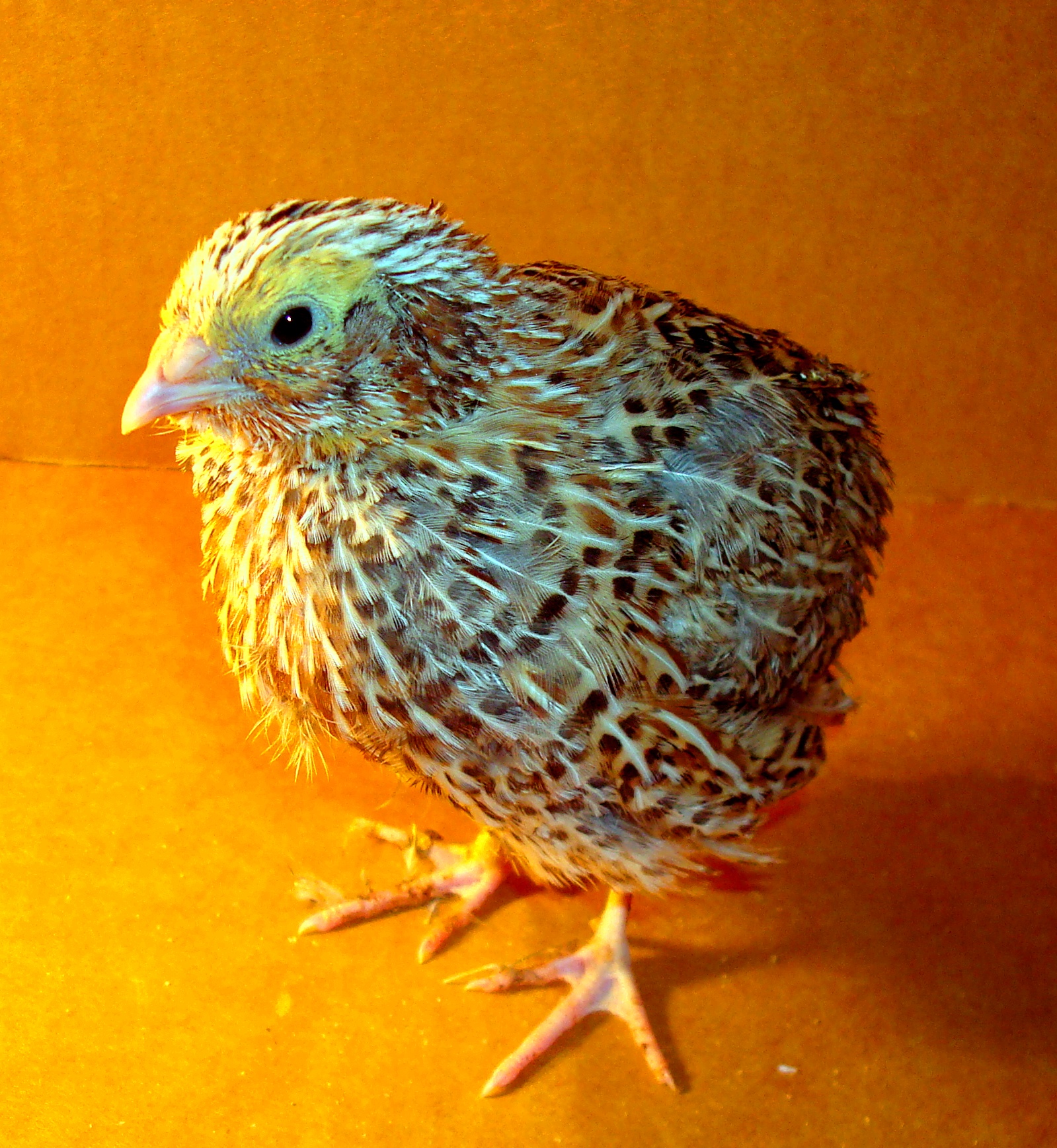
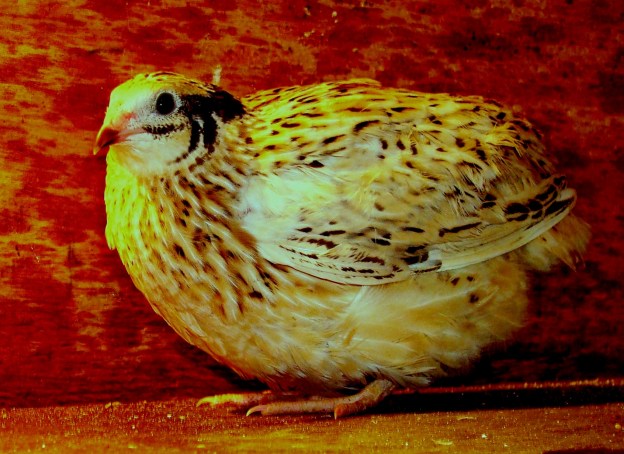
One of the selection criteria applied is 21 day old mass of birds. This figure has through selection increased slowly but definitely over the past year from 81 g to the present 103 g average. A few of the latest group of candidates :

2014-06-10 11.49.342014-06-10 11.58.172014-06-10 12.02.012014-06-10 12.04.182014-06-10 12.04.452014-06-10 12.06.532014-06-10 11.53.152014-06-10 12.06.532014-06-10 12.08.362014-06-10 12.09.142014-06-10 12.10.48

Inside the Quail Production Unit

As there are so many interesting discussions going on about quail housing, here is  a closer look at the inside my quail house.

111

Units consist of 30 cages (six high and five wide) each being 600 X 600 mm, housing four females and a male or six females. All cages have a easy removable front feeder which gives easy access to individual cages, should it be required. Each cage also has a water drinker fed from a feeder tank. Some of the cages have  a removable wire partitioning for gradual introduction of new birds. The units are inside a room with adequate cross ventilation but no direct drafts. No additional heating is supplied.

116115

Clean home mixed feed is fed on a ad lib basis with easy access to feeders for regular supervision.  Enough feeder space, easily accessible for the birds, is supplied to eliminate competition at the through

117

Clean fresh water through water cups is provided at all times

113114

Floors are laminated ply wood and is removable, much easier on the birds than wire. The second photo shows how a clean floor board is slid under the used board, and the latter pulled out from the top. In the pictures the feeder has been removed for demonstration purposes only, but in practice the change of floors, which takes a few seconds, is done with the birds inside and feeders in the normal position – often the birds do not even notice that the floor is being changed. Now the dirty floors can be cleaned and be ready for the next change. I do mine about once every two weeks.

121119

Each cage is fitted with a sand bath large enough for all the birds to be inside the bath at the same time if they so wish. Lighting is shielded, providing a soft glow that has a  calming effect on the birds.

118

The unit accommodates  up to 180 birds and takes up about 2 square meters of floor space, with enough space for the individual birds to relax and produce optimally. Birds are not kept on wire at any stage in time, as so many people do, as it is not beneficial to their health and well being. My birds are docile, calm, relaxed and happy and most of the time, when entering the room, with many hundreds of birds inside, there is not a sound as all the birds are calm, quiet and happy.