Cooking for Family and Friends

Make sure to pick clean, ripe elderberries and remove all the leaves and stalkes. Wash well under running water.
Crush the berries to create a must – I use my PASSATUTTO machine which works very well for this.


Once you have your must, pour it into a large enough container to hold all the product and have some spare space to allow for foaming during the first few days. Now add about three litres of boiling water for every litre of fruit. Close it well and leave it for one day to sterilise the must. Add pectinase enzyme and leave for another day. Adjust the pH and sugar contents, add your wine yeast and yeast nutrients and ferment on the must for about ten days. Remember to stir twice a day and always use clean sterilised equipment. Always close the container well to prevent contamination and fruit flies getting into the must.
After 10 days, rack and filter and adjust for sugar if required. Now pour your wine into a large enough Damigiana to make sure their is not too much air space, then put on an airlock and wait.
Rack and filter when the ferment is becoming clear and sediment is visible (about 2 – 3 weeks). Every time you work with the wine, top the Damigiana up to the neck with similar sugar content syrup or fruit juice. Airlock and ferment.
After another few weeks the fermentation will become slow and it is then time to rack, filter and top up again.
Make sure the fermentation has stopped completely before you rack, filter and bottle.
Leave it alone for a month and ENJOY!!

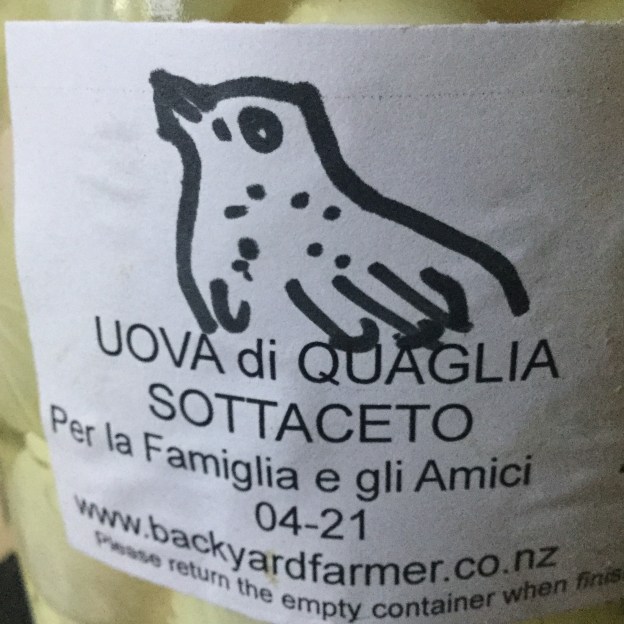
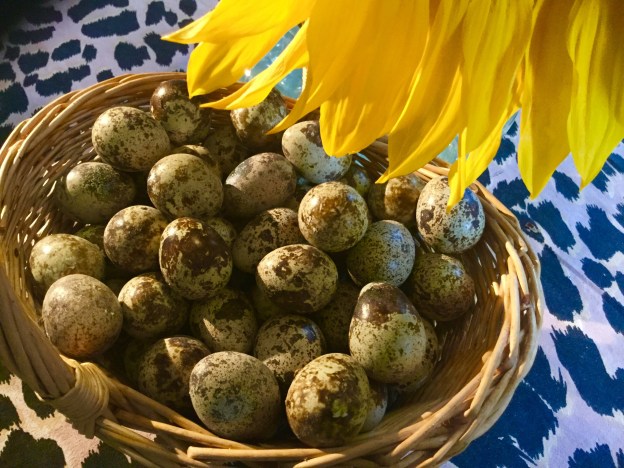
Today I had my 8 year old Grandson to assist me in making Pickled Quail Eggs. He was also the Director, Photographer and Script Writer for this post.
Once you have peeled the eggs , pack them in a clean sterilised bottle mixed with your chosen fresh spices. In this case we used rosemary, garlic, chili, salt and black pepper.


Boil enough 80:20 White Wine Vinegar : Water for 10 minutes, including all the spices, to cover the eggs. Pour the hot wine vinegar mix over the eggs until the container is full. Seal immediately and leave to stand for at least one week before use. If you want to preserve these for longer periods, pasteurise the full containers by boiling them for 30 minutes in a pot with water covering the containers completely.
These are obviously very good for any antipasto plate, or a late night snack with a glass of wine – ENJOY!!!
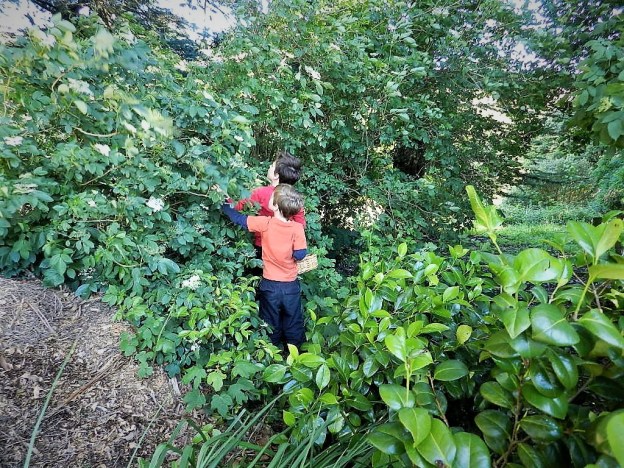
The Elder Flower Pickers hard at work. We had a trial run a few weeks ago making Elder Flower Sparkling Wine. It was delicious. We set out to harvest enough before the flowers disappear, at which stage we will attempt elderberry wine!
Vino di Sambuco ( elder flower wine ) Recipe as it happened step by step
2018-12-03
Add about 1 Liter Elder flowers, stems removed, to a 10 L plastic drum and cover with 5 Liters of boiling water – seal
2018-12-04
Stir in 1 Kg of Sugar until dissolved
Ad lemon zest of four lemons
Ad lemon juice of four lemons (about 210 ml)
Re – hydrate yeast by adding 6 g ‘GoFerm’ and 5 g ‘Lalvin EC1118′
(the seller is called Make Wine) and 50 ml of cooled boiled water Leave for 30 minutes
Add re – hydrated yeast to the must
Add 4 g ‘Ferm Aid ‘ to the must
SG (Specific Gravity measured with a Hydrometer to determine the sugar content) – 1.055 (Ad more sugar later)
Stir very well and put lid on tub – ferment on the must
Stir twice daily
2018-12-08
Rack and filter into two X 5 Liter Damigiane or large glass wine bottles. Top up with about 0.5 Liter each of 1.09 SG sugar syrup
Airlock and Ferment
SG – 1.06
2018-12-11
Rack and Filter
Airlock and Ferment
SG – 1.04
2018-12-15
Rack and Filter
Airlock and Ferment
SG – 1.02
Top up with 200 ml (100 ml per Darmigiana) of SG 1.09 Sugar Syrup
Taste – Pleasant, sweet and a bit bubbly
SG – 1.04
Airlock and Ferment
2018-12-20
Still fermenting slowly
SG – 1.02
Rack, Filter and Bottle in a Champagne bottles
Drink and ENJOY!!!
Rabbit and Pork Spiedini ready for the fire when it is hot enough

 Back Yard Farmer