CRABAPPLES

2014-03-22 11.50.09 2014-03-22 13.05.29 2014-03-22 18.04.50


Crabapple is not a fruit I have had much experience with in the past, but my BIG crabapple tree at my new house in Dunedin has forced me to have a closer look at possibilities  regarding these beautiful little fruits. I have spoken with the experts, borrowed cook books from my neighbors, googled, took advice from bloggers and, after a lot of reading picked about 10 Kg of crabapples (still have about 30 Kg left on the tree). I have decided to start with crabapple jelly. Most references suggested throwing the pulp away after extracting the juice, but my “use all and throw nothing away” culture has compelled me to do something with it. So here is what I did

10 kg crabapples

10 liters Water

Boil for about 20 minutes

Separate the pulp and juice by filtering through cheesecloth and put the pulp aside

JELLY

Heat the juice to boiling point and add  1 Kg  Sugar for every kg of liquid.  Simmer the mixture until it reaches setting point. Quickly, while still hot and before it gelatinises, filter again through cheesecloth and bottle. Seal bottles and sterilise in a boiling bath for 20 minutes. The clear, pink jelly sets beautifully and is delicious. I also made a batch where I added chili and rosemary to the original fruit – a very interesting and  tasty jelly resulted and I would probably make some more.

JAM

I have taken the pulp and put it through my Italian tomato pasata machine, which separates the skin and pips from the fine pulp. Heat the pulp to boiling point and add  1 kg of Sugar for every kg of pulp. Simmer the mixture until it reaches setting point. Seal bottles and sterilise in a boiling bath for 20 minutes. Beautiful and absolutely delicious jam.

The skins and pips I am using to make alpple cider vinegar. I think it will be good, as I normally use the cores and skins of ordinary apples to make this. I make large quantities of vinegar every year, of which I use most as is, but convert some to a mosto cotto

ROASTED CRABAPPLES AND HONEY

I have dribbled some fresh crabapples with honey and roasted them in the oven until soft, then served with home made custard – I never thought crabapples could taste so good, even though it was on the sour side where the rest of the household was concerned.

This week I am going to try making crabapple chutney and a  cider. After all that I should  still have another 10 kg of fruit left on the tree.

I find it strange that the big kereru pigeons do not eat the fruit  since they stripped the cherry trees and had a good go at the plum tree.


The Curse of the Cookbooks

2014-03-06 09.22.32

I had to photograph the result of a cooking discussion or, cooking bickering, if you must.

The great thing about being self sufficient and eating from the vegetable patch is the joy of harvesting something one grew oneself. It is organic and fresh even if, at time whatever is harvested is gnarled and puny it still tastes wonderful. The bad thing is that one is held hostage by the blackbird that eats all the seedlings the chickens overlooked when they were free ranging last time. The seasons and climate, especially here in Dunedin , dictate whether things grow or not and the person in control of the garden constantly suffers arched inquiries as to why in the world so much (or so little) of something was planted

Sometimes there is a glut of something and then the search for a great recipe, or, often many great recipes of one particular vegetable or fruit depending on the amount harvested. The frantic paging through the cookbooks begin, and since my 200 plus books are all about regional Italian cooking the search can not be narrowed down to, say, Indian or Chinese, and mutterings of  ‘ it was always in this book, where has it gone’ are commonplace. A lot of time is spent getting side tracked when I see something fondly remembered or something I always wanted to try. Once the recipe is selected sudden resistance from the household to the ingredients could flare up, prompting the beginning of a new search and the hauling out of more books!

Apricot and (Dunedin) Rosemary Jam


2014-02-23 16.10.542014-02-26 12.33.02

I am a bit of a jam tragic, if there is anything in abundance I need to make jam from it (or preserve it one way or another). I have a lot of apricots and Dunedin has a lot of rosemary. There are no genuine Italian food ingredients to be had over here, apart from all this rosemary. It grows in every garden, cascades down garden walls in the university grounds, grows vigorously several public spaces, parks, everywhere but in my garden. Why the inhabitants plant so much of it, I can not fathom, since I can not believe that they cook with it. But, I seem to be the only person in Dunedin who has not succeeded in growing a single sprig.  To get my hands on rosemary I have to resort to theft from lush bushes of the stuff overhanging various pavements around where I live.

Apricot and Rosemary Jam 

3 Kg Ripe Apricots

2 Kg White Sugar

20 g Finely chopped Rosmary leave

15 g Apricot Stone kernels, finely chopped

Cook everything together in a big pot for half an hour. Let it rest for some 12 hours.  Cook again until the jam consistency reaches the “Freezer Test ” thickness. Stir in a tablespoon of butter and take it off the heat. When it is cool enough to handle. bottle and seal. Sterilise the closed bottles as described before.

This flavorsome jam is ideal for eating with strong cheeses and using as a glaze for pork and poultry.

Cherries in Brandy

2014-02-14 17.01.58

I am prepared for the winter when there will be no cherries at all. I shall be drinking the cherry infused brandy and eating the cherries in front of the fire!

Cherries in Brandy

350 g   sugar

1 liter  brandy

Ripe, unblemished cherries, stalks on, washed. stones in

sterilized jars

Dissolve the sugar in the brandy. Cut the end of the cherry stalks off leaving about 1/2 of the stalk on the cherry and prick the cherry with a needle on the opposite side of the stem. Pack the cherries in the jars, ensure that the jars are full enough so that the cherries will not float around later. Pour the brandy mixture in the jars, make sure that all the cherries are covered. Store in a cool dark place for 3 months before eating.

I try very hard but I  always eat mine up long before the 3 months are past and they always taste wonderful!

Apricot Time

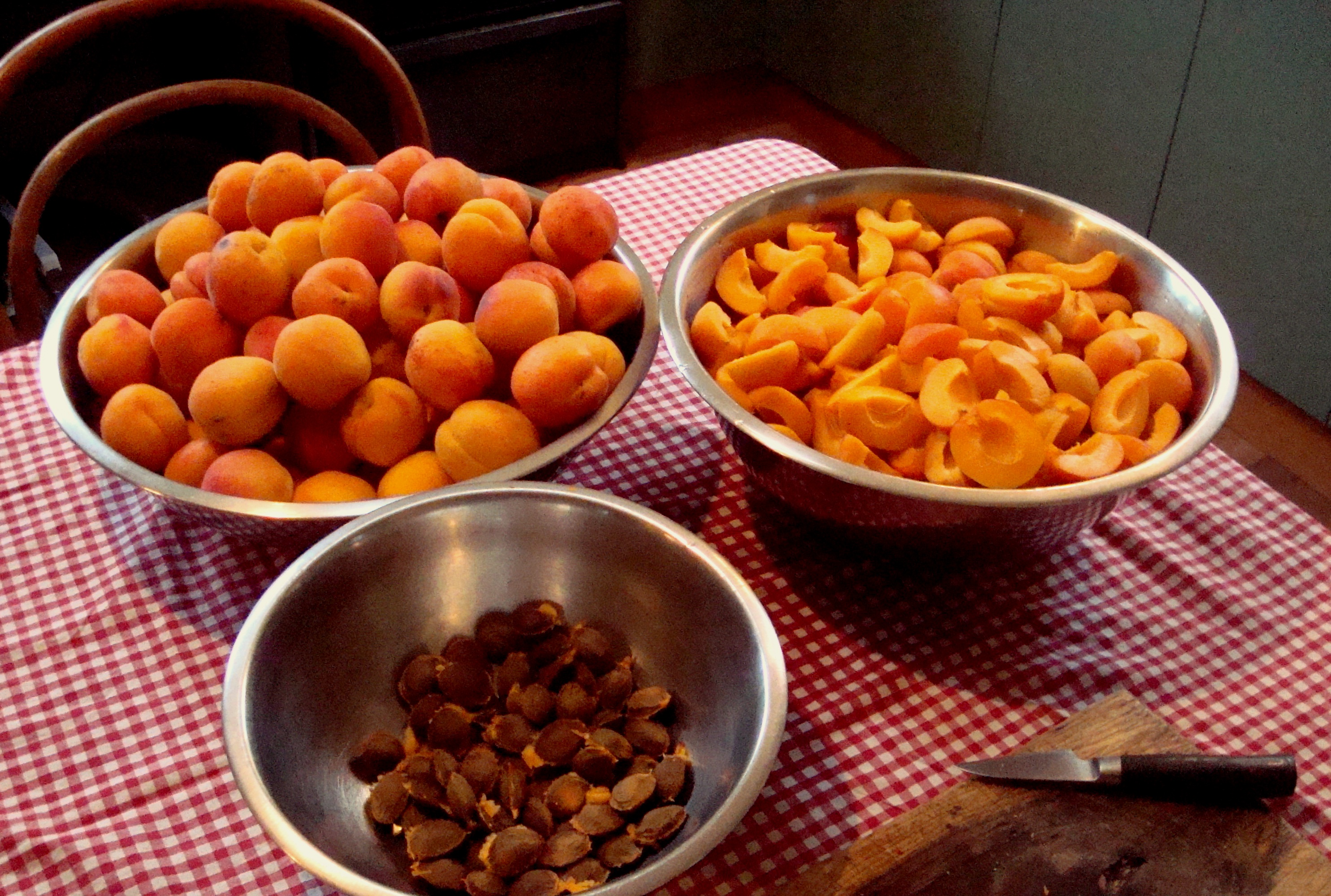
2014-01-19 - Apricots

The apricots are beautiful and sweet at this time of the year in Dunedin and I am preserving as many as possible.

APRICOT STONES

Never throw the kernels away as it is a wonderful flavoring for  Amaretti Biscotti, Amaretto Liqueur, Almond Extract for cooking and Almoncello ( a liqueur I make similar to Limoncello, but with Apricot Stones). Apricot kernels are used to intensify the flavor of almonds and have been used for hundreds of years. A little goes a long way. Yes they contain some cyanide, but are not dangerous unless a lot is consumed. Do not eat them as snacks like one would eat almonds for instance. There are a lot of unsubstantiated claims that it cures cancer as well. Recipes for cakes and drinks when I start using the kernels!

APRICOT JAM

Wash and quarter the apricots. Put 3 Kg Apricots, 2.5 Kg White Sugar and 200 ml Lemon Juice in a large pot and boil slowly. Do not add water. It may be difficult in the beginning, before the sugar has melted, to turn the mass over, but be careful and turn it over frequently without damaging the fruit or letting the sugar burn at the bottom. As soon as the sugar starts to melt it is easy to stir. It is easier to use a larger pot than a smaller one. Boil slowly for half an hour, stir frequently and skim off the scum. Turn off the heat and let it rest for at least 12 hours for the flavors to amalgamate and intensify. Boil again slowly while continuously skimming off the scum.  When the jam reaches the correct density using the Freezer Setting Test, turn off the heat. Bottle as soon as the jam is cooler and easier to handle. Seal the containers and sterilise with the Hot Bath Method.

Freezer Setting Test – Place a small plate in the freezer for a couple of minutes. When well cold remove from the freezer and put a teaspoon full of the jam onto it. If it is the correct consistency after a minute the jam is ready. If it is still too runny, simmer some more and repeat test later until jam is ready to be removed.

Hot Bath Method – Sterilise bottles of jam by submerging them into water in a large pot (bottles must be completely covered by water)  and boil for twenty minutes after the water and jam bottles commenced boiling. Remove and let cool.