The breeding program is going well
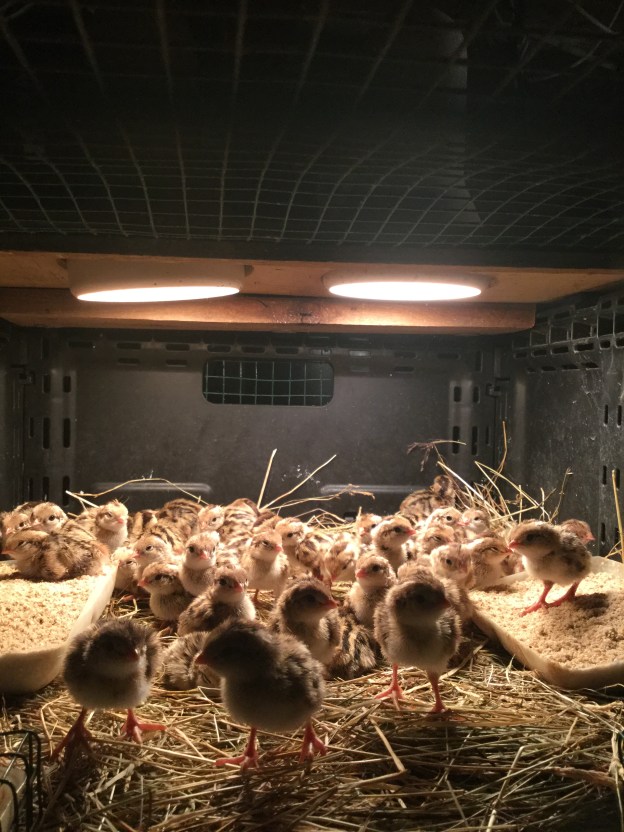
Callipepla californica EXPLOSION
The breeding program is going well
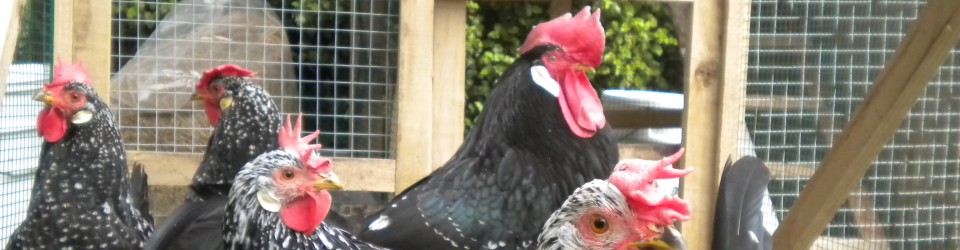
Coturnix coturnix
The breeding program is going well

If you are so cute and weigh 195 grams at 22 days of age, your destiny is definitely the breeding palaces of Back Yard Famer. http://www.backyardfarmer.co.nz
It will be hard to find a better light dinner than quail eggs topped with truffles and home cured salmon on the side. All washed down with good hand crafted Home Made Wine (organic and preservative free)


NEW FEEDING REGIMES
For Coturnix coturnix and all other Wild Birds
Combining my experience in animal nutrition and husbandry with extensive reading regarding the latest nutritional developments I am now manufacturing feeds that are very advanced in approach. These feeds benefit high performing quails as well as all other wild birds. My birds are performing so well on these feeds that I have included these formulas in all the feeds I offer for sale.
My strategy is to maximise digestibility using the simplest and best combination of materials and feed additives. I also utilise proven probiotics / prebiotics to stimulate and enhance the naïve gut, creating a favourable environment for good gut flora to proliferate and keep cell junctions tight. The rations also assist gut enterocytes with function and repair, while there are some elements in the feeds that help the modulation of immune responses.
I have formulated to specifications for Quail Starter, Grower and Layer feeds as top of the range diets by introducing new additives in addition to the present Vitamin and Mineral Pre Mix. These additives contain extra Lysine, Methionine, Threonine , Isoleucine and Valine which is intended to fully balance all the digestible amino acid ratios. These additions also lift the protein and energy digestibility beyond their stated levels on paper by using 4 separate and specific feed enzyme activities. The extra additives contain bioactive Vitamin D (Hy-D), Vitamin C, and Calcium Carbonate for bone modelling and antioxidant properties. Kelp meal, minerals, electrolytes and some sources of protected Butyrate, Carvacrol and Thymol steer good flora and discourage overgrowth of pathogenic bacteria and organisms. These new additions also contain a Mannosidase enzyme to aid the digestibility of various materials with proven Phytase, beta Glucanase, Xylanase and Protease enzymes.
My new feed formulations are the ultimate diets for quail and wild birds. All the above inclusions are essential and unique and take care of all amino acid balances using standard materials, supercharging the opportunity across all fronts for the birds to start well, grow well and produce well. There is plenty here to give bumble bee sized chicks, as well as mature birds, every chance to thrive without antibiotics, which is a big plus. These feeds are not only essential for wild birds, but give all poultry that extra boost when under stressful conditions.


Every so often in the farming industry you realise that progress is slower than expected, which is where I am at present with my Quail Breeding Project. I have made substantial progress over the past three years breeding Coturnix coturnix Quails in New Zealand, but find it more difficult to keep the coefficient of inbreeding low whilst applying the same selection pressure. One of the problems is small numbers of animals and the second being the lack of similar, or better, breeding animal availability in New Zealand.
To maintain progress, I have decided on a two pronged approach for the immediate future:
1) I am going to amalgamate the four breeds I presently have into only two breeds. I am going to join the Pharoas and Tibetans (Back Yard Specials as I have been calling them) and call this my Back Yard Dual Purpose Bird and apply the same selection pressure on both egg production and body mass. Then amalgamate the Italians and Whites and call them my Back Yard Egg Laying Bird. This will give me larger numbers to use in each breed and as I am not going to select for colour any more, progress will hopefully be faster. I suspect the two breeds will eventually be a darker coloured bird for the dual purpose breed and a lighter coloured bird for the egg laying breed.
2) I have had a very close look at the latest developments in animal nutrition and have incorporated some very exciting new elements into the feed. For details about the feed developments I have adopted, see my next post on this matter.
Hopefully these two changes that I have adopted will enhance progress in my project.
 Back Yard Farmer